fiebichpvJune 27, 2011, 7:25pm
Gathering of Eagles
(Trip experience = The destination fun)
THE BEGINNING
Much of our small plane VFR flying depends upon the forcasted weather. It is wise to heed all the data we can accumulate when planning flights, especially if they are multi-day ones.
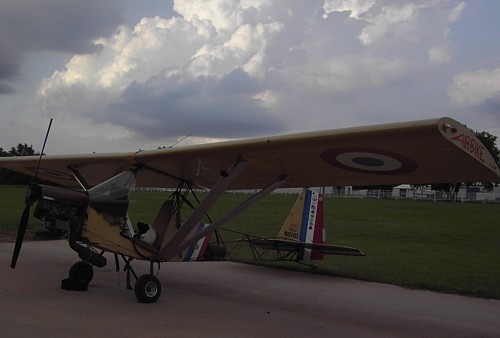
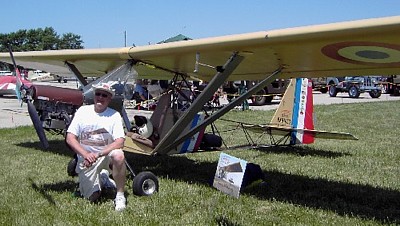
Such was the case last June 17th and 18th (Fathers Day weekend) as I planned my overnight trip to Gardner, Kansas (K34) to attend the Gathering of Eagles fly-in sponsored by EAA chapter 200. Accepting the predicted 100F degree temperatures as status quo for this time of year, I closely watched the developing storm predictions: “Scattered thunderstorms, some severe” for Friday night. That ruled out my tying down the AirBike at K34 and my sleeping in a tent! The reason my AirBike has lasted 13 years and 870 flying hours is that I take care of it when traveling.
Plan “B” involved making the trip to K34 with an overnight stop at Emporia (EMP) Friday, then continuing on Saturday morning. At 6:00 PM on Friday, my 342# AirBike was loaded to gross at 700# as it lumbered down the Selby Aerodrome 1200 foot grass runway. Jabara ASOS stated 100F degrees and Density Altitude at 4000 feet. That didn't have much meaning until at the runway's 600 foot mark, I was still only fast taxiing instead of flying. At 800 feet the AirBike lifted off the sod---however, ever so slowly!
The plane just wasn't much interested in flying! Clearing the runway end at five feet, I climbed through the crosswind turbulence created by trees bordering the runway. After passing through the opening in the row of windbreak trees, my next concern was to avoid the center pivot cornfield sprinkler. Climbing ever so slowly, I cleared it by 30 feet and didn't get my feet wet. I now have a new respect for DA when the AirBike is loaded to gross! I have also established a new performance limit.
A front quartering headwind greeted me as I flew northeasterly along I-35 and was consistently outdistanced by the turnpike traffic. Not an unusual situation. Twenty miles north of the Matfield Green service center I angled east into a direct headwind as my flight path took me to Emporia Airport. Repeated radio calls from 10, 5 and 3 miles out seemed to take me for ever to get closer. You don't cover much ground at 45 MPH. Listeners must have thought I was doing 360 degree turns. But I was going as fast as I could.
AREA STORMS AT EMPORIA
Sometimes things work out just right. Taxiing up to the Emporia Airport hangar, Don Tevis, airport manager waved me inside. Said “there's a storm a-commin' this way.” His meaty handshake made me feel welcome. I arrived too late for their monthly Friday night steak fry, but Don had saved me a plate full of food. Wow, what a nice supper and a considerate fellow!
An hour later we were swimming in his pool and “chillin'-out.” I was bunked down in the air conditioned Pilot Lounge when the storm hit about an hour later. Then the power went out for about three hours. What a storm! Later I would learn that the same storm ripped through Gardner and shoved one plane into another damaging both. Sure glad I was hangared that night!
SATURDAY'S FLIGHT TO GARDNER
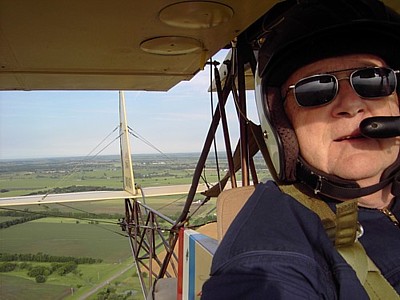
By 8:00 AM I had lifted-off and was on the 70-mile leg to Gardner. What a beautiful morning! Air was clear, everything looked “washed” but potential off-airport landing sites were severely reduced because of flooding and soggy fields. An in-flight “breakfast” of a nutrition bar and bottle of water would have to take the edge off my hunger pangs until reaching Gardner. Hint: Don't try to eat a chocolate covered treat in 90 degree weather nor open a water bottle in the cross-flow of turbulent air in the open cockpit! You will look like one of the Ink Spot singers who just got out of the pool!
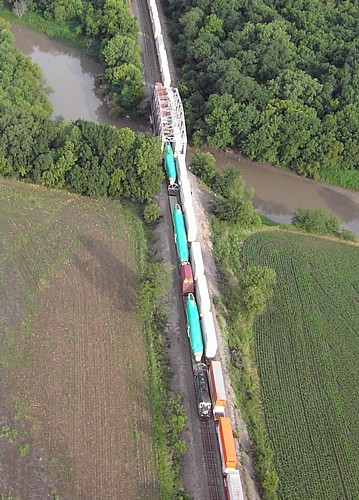
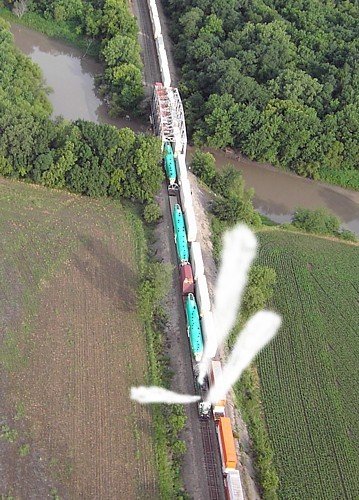
Imagining myself as the full-blown WWI fighter Ace, I spotted a target of opportunity approaching from my left. Pushing the stick forward and left I began a descending turn. Lewis machine gun cocked, my warbird began its screaming dive towards a lumbering train. Its main cargo were three sets of twin flatbed railcars on which were mounted airplane fuselages bound for a destination where they would get their wings. Pop! Pop! Pop! The Lewis gun rattled off a full belt of shells in its typical slow staccato fashion.
First the steam engine's boiler blew, spiraling a fountain of steam skyward as the engineer and coal stoker jumped from the cab. Flying down the row of train cars, I strafed and perforated everything in sight. That which didn't catch fire, leaked liquid and the airplane fuselages were rendered useless. My thought are, if I fly a dinky little airplane, I had better have a great imagination!
Leaving the smoking, leaking and burning carnage on the tracks, I turned once again towards my destination at Gardner Municipal Airport.
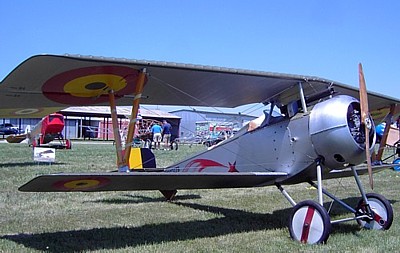
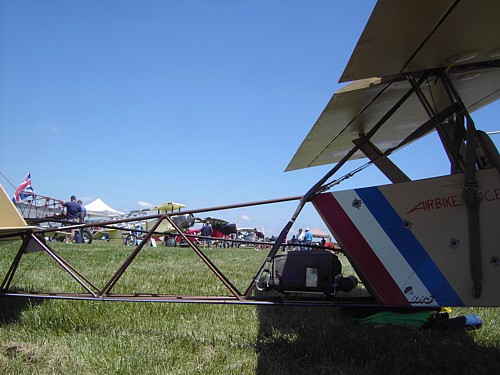
Following my signature smoke pass down runway 08 (the “show line”) I landed on the grass, taxied to a parking place next to a Dawn Patrol's Nieuport and had the traditional pilot breakfast in the shelter. I had hardly sat down with my food when the two fellows next to me struck up a conversation. Hey, it really feels nice to immediately be visiting with fellow pilots. Some were old friends, others became new ones.
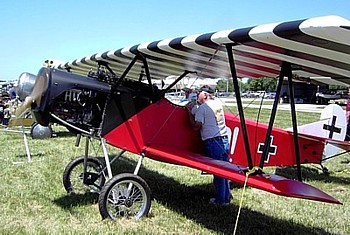
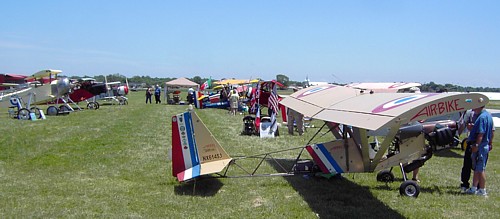
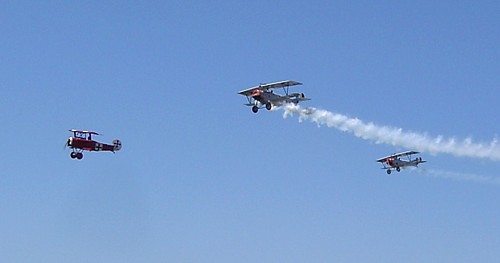
Gathering of Eagles fly-in is known as the opportunity to display WWI aeroplane replicas and do lots of flying. There are no contests, no awards, no judging. Just plenty of small conversations centered around the pilots/builders discussing their planes. Additionally, someone was in the air all the time. Three planes seemed to be about the maximum reasonable to avoid congestion. Around and around the triangular shaped runways they went. Some making slow passes, others smoking, and still others flying in some type of loose formation (they all went the same direction).
FLYING FOR FUN AT GARDNER
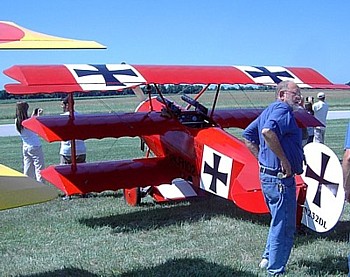
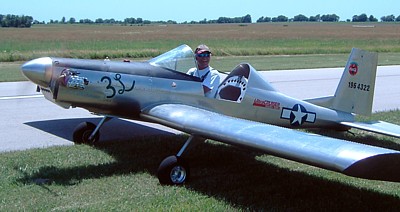
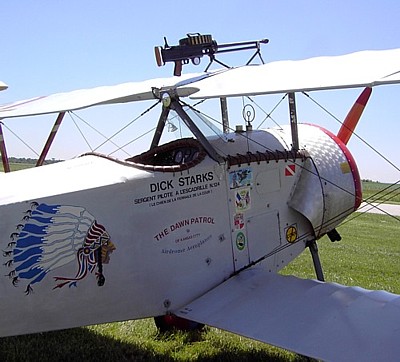
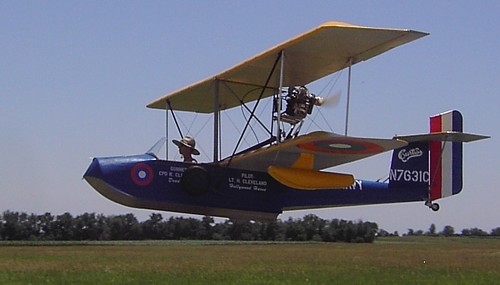
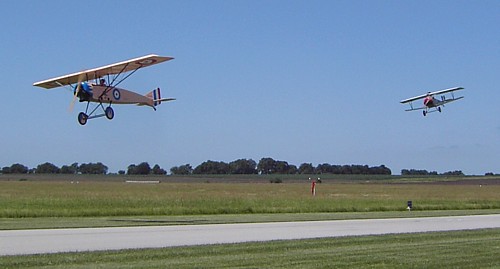
Sharon in her Morane and Dick Starks in his Nieuport, flew in trail. Soon joined by another flier. Over the course of the day almost every one of the 15 flyable scaled down replica planes took to the air. It truly was a gathering of eagles: A Spad, Nieuports, Fokker Dr-I, Mariner amphibian, Siemens Schuckert, two AirBikes and several GA planes such as a Hummel Ultra-Cruiser, Aeronca Champ,and a Sonnex completed most of those flying. On the ground were Fokker D-VII (with a working acetylene powered audio system for it machine guns), Sopwith, Fokker D-VIII, and numerous planes in various stages of construction.
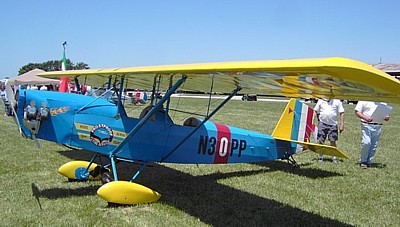
The Central Powers planes were outfitted with Spandau machine guns while the Allies used those made by Lewis. Each plane was painted in its national colors representing France, Germany, Britain, and others. Power plants included two and four-cylinder VW engines, Rotec radial, Rotax, Generac, and one Suzuki automobile engine.
Weather conditions were similar to Friday's. With about 5-1/2 gallons of fuel remaining in my wing tanks, I lightened my ship by removing all the traveling gear and ten bottles of two-stroke oil. AirBike engine warmed up, I waited in the grass for one of the circling planes to land. Soon Sharon Starks brought her Morane down and taxied to her spot. I taxied out and began my demonstration flight. While taxing, the Dr-I landed and the Nieuport made a low pass over me. Cool!
For the next 20 minutes I circled the field passing the show line in various configurations: high-speed pass, slow-speed pass (really not much noticeable difference), “knife-edge” (sort of) with smoke on, wing-wag, and some near formation passes with the Nieuport. It was fun, that is what we are here for—fly for fun. I love this flying stuff!
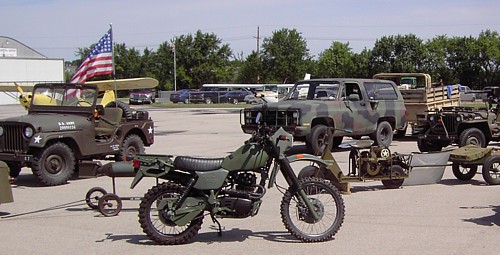
Not all displays were aviation. A military reenactment group showed off their Jeeps, Cushman, Harley and Suzuki motorcycles, and vehicles pulling carts with bombs on them. All personnel was dressed in military garb and eagerly engaged conversations with spectators.
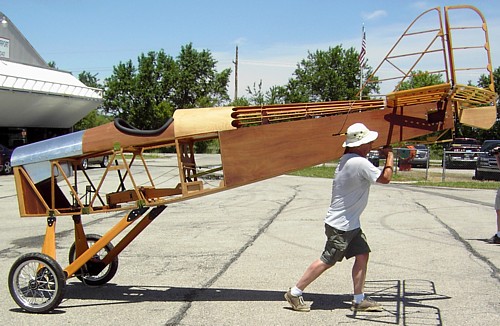
This is the place to be to learn about WWI airplanes. I met a fellow from Florida and another from Ohio who came specifically to see what others are doing with their replicas. Everyone has something different and unique about their aerial steeds; it could be a chain-saw starting motor, automotive engine with a re-drive, paint scheme, construction method, detailed fairing or simulated machine guns. Most planes had display panels describing them while offering “business cards” and other literature.
Sharon Starks' planewas a real popular display, her Morane is an eye catcher with its paint scheme and low rpm Generac motor. She is an excellent ambassador for women fliers. And how lucky her husband Dick is that they both share the same activity. Sharon's plane was used in the movie, Amelia---a lifelong exposure of the famous aviatrix’s aviation adventures.
HEADING HOME
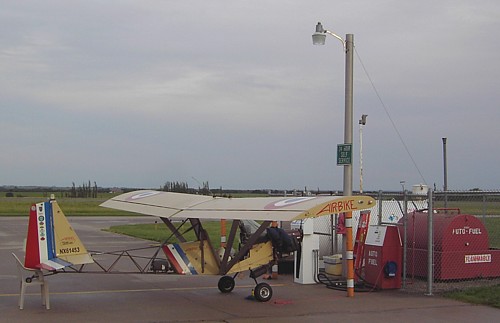
By 4:00 PM I was refueled, flight plan filed and ready to go home. Taking runway 17 I was going to enjoy the 3370 foot long spread of sod in front of me. I kept the plane on the ground until its speed reached 45 mph then I lifted off with authority and pointed the nose towards EMP. A 10 mph tailwind helped me along but speed is relative when there are no cars below to use as a reference. I was flying diagonally across farmland, in Kansas most roads go north and south or east and west. I WAS, however, outpacing the combines gleaning wheat from the fields below!
Having flown this route many times, I didn't turn on the GPS. What a feeling of comfort to fly over familiar territory and not worry if I was lost---again. But then, are you lost if you really don't care where you are? The wind had picked up as I landed at EMP, I did not know what lay in the next 80 miles ahead of me though. I would soon find out and that would notch up the pucker factor. Refueling finished, I bought a cool Pepsi and watched the weather report on the FBO's TV---Storms rapidly approaching my destination---gotta get going.
STORM CLOUDS & WIND
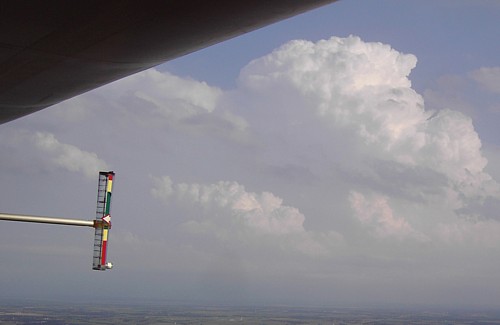
When filing my flight plan I noted two alternate airports in case I didn't beat the approaching weather. One was El Dorado and the other Augusta. Although in bright afternoon sunshine, I could see cumulus clouds building way off to my left front quarter. This caused me concern and I firmed up the decision to use the alternates if necessary. Passing the Matfield Green service area I noticed that I was going faster than the turnpike traffic. Wow, that is nice! Turning on the GPS it displayed my ground speed at 82 mph! Yikes, I was getting a boost from that trailing wind.
Marking the cloud location with a position on my aircraft I could see that I was gaining on the storm. If things went well I would arrive at Selby Aerodrome before it did. That was comforting. Then things started going better than “well.” Near Lake El Dorado, I turned on the GPS and discovered I was now at 4,500 feet AGL and traveling 96 mph! I would make the aerodrome ahead of the storm without a doubt---pucker factor relaxed considerably.
Zooming over Towanda and then the edge of Augusta Airport, the storm was now behind me and about 20 miles away. That was my minimum comfort zone. Swinging west of McConnell Air Force Base I was now down to 2000 feet AGL and into some turbulent air. Skirting Derby on the east and south sides I soon crossed the Arkansas River and Selby aerodrome (35KS) came into view. Sighting the windsock as I flew directly over the runway's midpoint, the best landing direction was runway 35.
Descending and entering the downwind and base legs brought me into more turbulence, I worried about the wind rotors coming off the treeline bordering the runway. Sure enough, on final and now down to 50 feet it was like rafting the Colorado River during spring thaw. Squirley doesn't describe my flight attitude. If I had a machine gun and was shooting at a target, it would have been safe! Touching down just past the runway threshold (to miss the tires) I pulled on the brakes only enough to slow quickly but not put the prop in the dirt. I needed to kill the airspeed fast, least a gust of wind toss me airborne, it easily could have.
THE ENDING
Taxiing to the hangar door I shut the engine off then rolled backwards a few feet when its thrust no longer equaled the ramp's incline. Dropping my feet from the rudder pedals to the ramp, I sat there a few minutes to get my land legs back. While doing so, I looked at the sky and said “I'm glad to be down here looking up than up there wishing I was down here.” It was just a little more than 24 hours ago that I left this field. I thought, what a great experience I have had covering 320 air miles while flying a total of 5 hours. What marvelous activities this little airplane has provided. I am satisfied---that is until another neat fly-in pops up on my schedule.
Paul D. Fiebich
a.k.a. AirBike Ace
02-26-2011
(Trip experience = The destination fun)
THE BEGINNING
Much of our small plane VFR flying depends upon the forcasted weather. It is wise to heed all the data we can accumulate when planning flights, especially if they are multi-day ones.
Such was the case last June 17th and 18th (Fathers Day weekend) as I planned my overnight trip to Gardner, Kansas (K34) to attend the Gathering of Eagles fly-in sponsored by EAA chapter 200. Accepting the predicted 100F degree temperatures as status quo for this time of year, I closely watched the developing storm predictions: “Scattered thunderstorms, some severe” for Friday night. That ruled out my tying down the AirBike at K34 and my sleeping in a tent! The reason my AirBike has lasted 13 years and 870 flying hours is that I take care of it when traveling.
Plan “B” involved making the trip to K34 with an overnight stop at Emporia (EMP) Friday, then continuing on Saturday morning. At 6:00 PM on Friday, my 342# AirBike was loaded to gross at 700# as it lumbered down the Selby Aerodrome 1200 foot grass runway. Jabara ASOS stated 100F degrees and Density Altitude at 4000 feet. That didn't have much meaning until at the runway's 600 foot mark, I was still only fast taxiing instead of flying. At 800 feet the AirBike lifted off the sod---however, ever so slowly!
The plane just wasn't much interested in flying! Clearing the runway end at five feet, I climbed through the crosswind turbulence created by trees bordering the runway. After passing through the opening in the row of windbreak trees, my next concern was to avoid the center pivot cornfield sprinkler. Climbing ever so slowly, I cleared it by 30 feet and didn't get my feet wet. I now have a new respect for DA when the AirBike is loaded to gross! I have also established a new performance limit.
A front quartering headwind greeted me as I flew northeasterly along I-35 and was consistently outdistanced by the turnpike traffic. Not an unusual situation. Twenty miles north of the Matfield Green service center I angled east into a direct headwind as my flight path took me to Emporia Airport. Repeated radio calls from 10, 5 and 3 miles out seemed to take me for ever to get closer. You don't cover much ground at 45 MPH. Listeners must have thought I was doing 360 degree turns. But I was going as fast as I could.
AREA STORMS AT EMPORIA
Sometimes things work out just right. Taxiing up to the Emporia Airport hangar, Don Tevis, airport manager waved me inside. Said “there's a storm a-commin' this way.” His meaty handshake made me feel welcome. I arrived too late for their monthly Friday night steak fry, but Don had saved me a plate full of food. Wow, what a nice supper and a considerate fellow!
An hour later we were swimming in his pool and “chillin'-out.” I was bunked down in the air conditioned Pilot Lounge when the storm hit about an hour later. Then the power went out for about three hours. What a storm! Later I would learn that the same storm ripped through Gardner and shoved one plane into another damaging both. Sure glad I was hangared that night!
SATURDAY'S FLIGHT TO GARDNER
By 8:00 AM I had lifted-off and was on the 70-mile leg to Gardner. What a beautiful morning! Air was clear, everything looked “washed” but potential off-airport landing sites were severely reduced because of flooding and soggy fields. An in-flight “breakfast” of a nutrition bar and bottle of water would have to take the edge off my hunger pangs until reaching Gardner. Hint: Don't try to eat a chocolate covered treat in 90 degree weather nor open a water bottle in the cross-flow of turbulent air in the open cockpit! You will look like one of the Ink Spot singers who just got out of the pool!
Imagining myself as the full-blown WWI fighter Ace, I spotted a target of opportunity approaching from my left. Pushing the stick forward and left I began a descending turn. Lewis machine gun cocked, my warbird began its screaming dive towards a lumbering train. Its main cargo were three sets of twin flatbed railcars on which were mounted airplane fuselages bound for a destination where they would get their wings. Pop! Pop! Pop! The Lewis gun rattled off a full belt of shells in its typical slow staccato fashion.
First the steam engine's boiler blew, spiraling a fountain of steam skyward as the engineer and coal stoker jumped from the cab. Flying down the row of train cars, I strafed and perforated everything in sight. That which didn't catch fire, leaked liquid and the airplane fuselages were rendered useless. My thought are, if I fly a dinky little airplane, I had better have a great imagination!
Leaving the smoking, leaking and burning carnage on the tracks, I turned once again towards my destination at Gardner Municipal Airport.
Following my signature smoke pass down runway 08 (the “show line”) I landed on the grass, taxied to a parking place next to a Dawn Patrol's Nieuport and had the traditional pilot breakfast in the shelter. I had hardly sat down with my food when the two fellows next to me struck up a conversation. Hey, it really feels nice to immediately be visiting with fellow pilots. Some were old friends, others became new ones.
Gathering of Eagles fly-in is known as the opportunity to display WWI aeroplane replicas and do lots of flying. There are no contests, no awards, no judging. Just plenty of small conversations centered around the pilots/builders discussing their planes. Additionally, someone was in the air all the time. Three planes seemed to be about the maximum reasonable to avoid congestion. Around and around the triangular shaped runways they went. Some making slow passes, others smoking, and still others flying in some type of loose formation (they all went the same direction).
FLYING FOR FUN AT GARDNER
Sharon in her Morane and Dick Starks in his Nieuport, flew in trail. Soon joined by another flier. Over the course of the day almost every one of the 15 flyable scaled down replica planes took to the air. It truly was a gathering of eagles: A Spad, Nieuports, Fokker Dr-I, Mariner amphibian, Siemens Schuckert, two AirBikes and several GA planes such as a Hummel Ultra-Cruiser, Aeronca Champ,and a Sonnex completed most of those flying. On the ground were Fokker D-VII (with a working acetylene powered audio system for it machine guns), Sopwith, Fokker D-VIII, and numerous planes in various stages of construction.
The Central Powers planes were outfitted with Spandau machine guns while the Allies used those made by Lewis. Each plane was painted in its national colors representing France, Germany, Britain, and others. Power plants included two and four-cylinder VW engines, Rotec radial, Rotax, Generac, and one Suzuki automobile engine.
Weather conditions were similar to Friday's. With about 5-1/2 gallons of fuel remaining in my wing tanks, I lightened my ship by removing all the traveling gear and ten bottles of two-stroke oil. AirBike engine warmed up, I waited in the grass for one of the circling planes to land. Soon Sharon Starks brought her Morane down and taxied to her spot. I taxied out and began my demonstration flight. While taxing, the Dr-I landed and the Nieuport made a low pass over me. Cool!
For the next 20 minutes I circled the field passing the show line in various configurations: high-speed pass, slow-speed pass (really not much noticeable difference), “knife-edge” (sort of) with smoke on, wing-wag, and some near formation passes with the Nieuport. It was fun, that is what we are here for—fly for fun. I love this flying stuff!
Not all displays were aviation. A military reenactment group showed off their Jeeps, Cushman, Harley and Suzuki motorcycles, and vehicles pulling carts with bombs on them. All personnel was dressed in military garb and eagerly engaged conversations with spectators.
This is the place to be to learn about WWI airplanes. I met a fellow from Florida and another from Ohio who came specifically to see what others are doing with their replicas. Everyone has something different and unique about their aerial steeds; it could be a chain-saw starting motor, automotive engine with a re-drive, paint scheme, construction method, detailed fairing or simulated machine guns. Most planes had display panels describing them while offering “business cards” and other literature.
Sharon Starks' planewas a real popular display, her Morane is an eye catcher with its paint scheme and low rpm Generac motor. She is an excellent ambassador for women fliers. And how lucky her husband Dick is that they both share the same activity. Sharon's plane was used in the movie, Amelia---a lifelong exposure of the famous aviatrix’s aviation adventures.
HEADING HOME
By 4:00 PM I was refueled, flight plan filed and ready to go home. Taking runway 17 I was going to enjoy the 3370 foot long spread of sod in front of me. I kept the plane on the ground until its speed reached 45 mph then I lifted off with authority and pointed the nose towards EMP. A 10 mph tailwind helped me along but speed is relative when there are no cars below to use as a reference. I was flying diagonally across farmland, in Kansas most roads go north and south or east and west. I WAS, however, outpacing the combines gleaning wheat from the fields below!
Having flown this route many times, I didn't turn on the GPS. What a feeling of comfort to fly over familiar territory and not worry if I was lost---again. But then, are you lost if you really don't care where you are? The wind had picked up as I landed at EMP, I did not know what lay in the next 80 miles ahead of me though. I would soon find out and that would notch up the pucker factor. Refueling finished, I bought a cool Pepsi and watched the weather report on the FBO's TV---Storms rapidly approaching my destination---gotta get going.
STORM CLOUDS & WIND
When filing my flight plan I noted two alternate airports in case I didn't beat the approaching weather. One was El Dorado and the other Augusta. Although in bright afternoon sunshine, I could see cumulus clouds building way off to my left front quarter. This caused me concern and I firmed up the decision to use the alternates if necessary. Passing the Matfield Green service area I noticed that I was going faster than the turnpike traffic. Wow, that is nice! Turning on the GPS it displayed my ground speed at 82 mph! Yikes, I was getting a boost from that trailing wind.
Marking the cloud location with a position on my aircraft I could see that I was gaining on the storm. If things went well I would arrive at Selby Aerodrome before it did. That was comforting. Then things started going better than “well.” Near Lake El Dorado, I turned on the GPS and discovered I was now at 4,500 feet AGL and traveling 96 mph! I would make the aerodrome ahead of the storm without a doubt---pucker factor relaxed considerably.
Zooming over Towanda and then the edge of Augusta Airport, the storm was now behind me and about 20 miles away. That was my minimum comfort zone. Swinging west of McConnell Air Force Base I was now down to 2000 feet AGL and into some turbulent air. Skirting Derby on the east and south sides I soon crossed the Arkansas River and Selby aerodrome (35KS) came into view. Sighting the windsock as I flew directly over the runway's midpoint, the best landing direction was runway 35.
Descending and entering the downwind and base legs brought me into more turbulence, I worried about the wind rotors coming off the treeline bordering the runway. Sure enough, on final and now down to 50 feet it was like rafting the Colorado River during spring thaw. Squirley doesn't describe my flight attitude. If I had a machine gun and was shooting at a target, it would have been safe! Touching down just past the runway threshold (to miss the tires) I pulled on the brakes only enough to slow quickly but not put the prop in the dirt. I needed to kill the airspeed fast, least a gust of wind toss me airborne, it easily could have.
THE ENDING
Taxiing to the hangar door I shut the engine off then rolled backwards a few feet when its thrust no longer equaled the ramp's incline. Dropping my feet from the rudder pedals to the ramp, I sat there a few minutes to get my land legs back. While doing so, I looked at the sky and said “I'm glad to be down here looking up than up there wishing I was down here.” It was just a little more than 24 hours ago that I left this field. I thought, what a great experience I have had covering 320 air miles while flying a total of 5 hours. What marvelous activities this little airplane has provided. I am satisfied---that is until another neat fly-in pops up on my schedule.
Paul D. Fiebich
a.k.a. AirBike Ace
02-26-2011