Building and Flying Related Boards › Flying Stories
Paul's AirBike Engine
30 posts
fiebichpvJanuary 12, 2016, 6:21pm
Paul's AirBike Engine
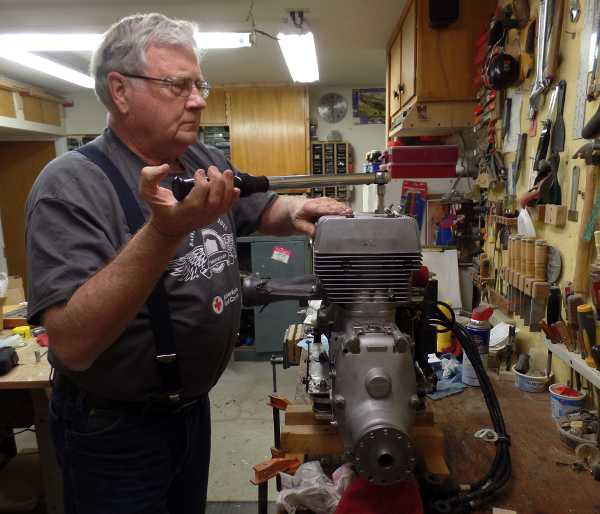
Whew! Yesterday I was able to get back to working on reassembling the Rotax 503 engine used on my AirBike following the cold seizure.
The replacement piston & rings, gaskets and, needle bearing installation tool arrived last week. Other priorities precluded my working on the engine then.
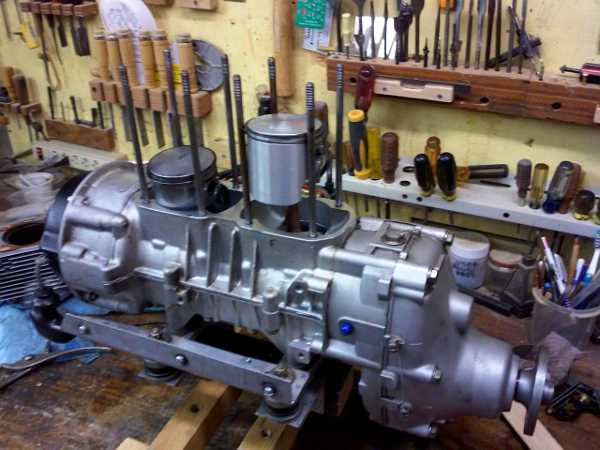
Following removal of the transferred aluminum from the piston onto the cylinder wall with Muratic Acid, I used a hone to clean it up and produce the necessary hatch marks. I decarboned the other piston and ring grooves while that piston was in place. The replacement piston is still "one over" (red dot) as was the case for both pistons during the last overhaul.
I checked the piston to cylinder clearance (.003), ring end gap (.016) and ring side clearance (.003) then began reassembly. All were within the specifications that one of you sent me a link to. That was very valuable!
First was the installation of the rod end needle bearings; what a job! After numerous failed attempts I abandoned half of the plastic bearing insertion tool. I finally decided to use a combination of one half of the plastic cage tool, a 13 mm socket, Lithium grease and got it assembled on the first try. I now have an established procedure that works. The piston was oriented with the text "AUS" pointed towards the exhaust port.
The circlips were somewhat of a pain. The first one went in right away. Using the same method on the other one gave different results. It must have taken about five tries and as many minutes to get it in.
My wife helped me to install the cylinders. She wiggled them into place while I compressed the rings with my fingers making sure the ring gap was straddling the pins. I installed new cylinder base gaskets, head gasket, and will use new exhaust port gaskets. Everything was torqued to specifications and in sequence per my reference materials.
Next step will be to install the engine on the plane, drain and replace the gearbox oil, then start the break-in procedure. I hope all goes well. I will let you know of the progress and eventually my test flights.
My cost to do this repair was $247.00 plus $20.00 shipping.
Thought you'd like to know that I am on my way to getting back in the air!!
Paul Fiebich
texasbuzzardJanuary 12, 2016, 6:38pm
That's great news Paul. sounds like you had lots of fun with the wrist pin needles...I sure did.
monte
stevejahrJanuary 12, 2016, 8:20pm
Paul,
You did not mention this but I hope you oiled up the cylinder walls and bearings with your usual 2-stroke oil as you put it all together?
Hope you got those circlips seated well... I had one come out on an engine once and it made a helluva mess of things.
aeronutJanuary 12, 2016, 9:20pm
It looks like you have a warm well illuminated place to work in. That is half the battle. Good luck with the brake in and please let us know how it is going. Best wishes.
never surrender; never give-up
fiebichpvJanuary 12, 2016, 9:32pm
Yes Steve, I dribbled Amzoil oil (same as what I mix with the fuel) on the main bearings and the crank to rod bearings. Also oiled both the cylinder walls and the piston prior to assembly. To make sure the torque values were accurate, I cleaned both the studs and the nuts with tap and die thread chasers. This goes for the spark plug holes. I can imagine the mess being made by the wrist pin clips coming loose. Mine are seated. I also used new 8 mm lock washers on everything.
Back in the '60's my brother and I rebuilt his '57 dodge engine only to find one wrist pin retainer lying in the grass (we were shade-tree mechanics). It took the removal of three pistons before finding the one with the missing retainer. Sure glad we didn't run the engine without it!
I will increase the oil to fuel mixture to be 75:1 (down from 100:1) until I am confident that no metal transfer is taking place. Next step after installation will be an hour or so of break-in. I will keep an eye on the spark plug condition and re-torque the head bolts after two hours of run time and again after 10 more hours.
Thanks for your concern Steve.
Paul
flydogJanuary 13, 2016, 12:03am
I will increase the oil to fuel mixture to be 75:1 (down from 100:1) until I am confident that no metal transfer is taking place.
And if you do find metal transfer taking place at 75:1, ....is that too late?
texasbuzzardJanuary 13, 2016, 12:18am
Paul for the break-in runs I would use a 50:1 mix to seat the rings in. IMHO
Monte
beragoobruceJanuary 13, 2016, 1:38am
I admire your skills as a 2 stroke mechanic. They certainly saved you a lot of money - and you know the job is well done. (By the way, the AUS is short for 'auspuff', German for exhaust. Great word, isn't it? )
Hope to see you safely back in the air soon!
Bruce
The TermiteJanuary 13, 2016, 1:52am
Quoted from texasbuzzard
Paul, for the break-in runs I would use a 50:1 mix to seat the rings in. IMHO
Monte
Ditto to what Monte said...........
Arthur WithyJanuary 13, 2016, 1:45pm
Great stuff Paul.....Im so pleased your wife assisted .....
and now for something different...........
The run in is all about wear and heat....and sufficient cooling ...with sufficient lubrication....so my advice is go with what you know works......regardless of oil ratios and brands....and then change to the Your oil of choice and do the run in a second time .....The plugs WILL tell the story. I Believe
regards Arthur
RicardoJanuary 13, 2016, 11:49pm
Good job Paul. For $ 267 you've got almost a new engine but the crank.
The TermiteJanuary 14, 2016, 5:59am
Here is the Rotax break-in procedure for the Rotax 2-stroke engines.
http://www.ultralightnews.com/enginemaintenance/breakin.htmMy $.02: I would use a non-synthetic oil for the initial breakin. Then maybe go to a full synthetic. Lightsport Aircraft CA says that also.
http://www.lightsportaircraft.ca/volume1-issue35/webcast-4/YMMV.
radfordcJanuary 14, 2016, 2:54pm
I too think it would be best to use the Rotax recommended oil (I always used Pennzoil) for breakin. Often synthetic oils don't allow the necessary friction during breakin.
fiebichpvJanuary 14, 2016, 4:40pm
I went to both of the suggested links. On the first one, I don't see any way to get to the break-in video/information. Going to the second one produces a panel that states that it isn't found? Can you be more specific? I will call LEAF today to get their input.
Thanks for your continuing support in this repair project. I will be putting the engine back on my plane today. Break-in will start when I have made a decision on which oil to use.
Paul Fiebich
tjspindlerJanuary 14, 2016, 4:43pm
.003" piston clearance I feel is a little on the tight side for a air cooled 2 stroke engine. .004 to .0055 is what the snowmobile manufacture that I used to work for goes with on there air cooled 2 stroke engines. This number is also used by two of the most prolific snowmobile race engine builders that build engines for many world champion race teams. It has no effect on engine life or performance and greatly reduces cold seizure.
I'm in no way telling anybody that .003 shouldn't be used on Rotax engines I'm just passing on a wealth of knowledge that I have gained working with 2 stroke engines for the past 35 years.
Ditto on not using synthetic oil during break-in and also a little extra oil helps too like 40to1. There's lots of metal to be removed and flushed out of the engine during break-in.
Tjspindler
fiebichpvJanuary 14, 2016, 9:23pm
It is unfortunate there is such a wide range of break-in procedures identified as being the way to do it. This makes the decision of what to do more difficult.
From the horse's mouth:
Regarding the questions associated with what oil to use during engine break-in, a conversation with Brett (a technician) at LEAF, revealed the following:
Either Amsoil or Penzoil can be used successfully during an engine break-in. If using Amsoil, don't make the ratio lower than 90:1 (100:1 is ok), if Penzoil, keep it at 50:1. They have used both successfully when breaking-in an engine.
Keep in mind that these are air-cooled aircraft engines, their components are different than those used in regular and racing snow machine use.
The clearances I noted above are within the specifications recommended by my Rotax reference material and LEAF.
I did replace only one piston and ring set, those were the components damaged by the cold seizure. I didn't replace the other piston or hone that cylinder because it was just fine the way it was.
I am off now to install the engine on the plane
Paul Fiebich
PS I did finally find the break-in information from the first link provided above, that is already the established Rotax procedure that I intend to follow. It did not say anything about what oil to use.
tjspindlerJanuary 15, 2016, 4:44pm
"Keep in mind that these are air-cooled aircraft engines, their components are different than those used in regular and racing snow machine use."
I'm sorry Paul but I have to reply to this statement. The only thing that makes this statement true are the obvious differences like duel ignition
components, machined crankcases so a redrive can be installed and etc. In the places where it counts like crankshaft assembly, bearings, rods, pistons, rings, etc. are the same. Every 2 stroke engine that Rotax has sold for a aircraft IS a converted snowmobile engine. The only reason Rotax quit selling air cooled aircraft engines are because that engine is no longer used in a much higher volume in there snowmobile production and Rotax will not spend the money to maintain the tooling required to produce that engine in such small quantities for us little airplane builders. From what I was told from a engineer that used to work for Rotax that now works for a US recreational vehicle manufacture that the 2 stroke aircraft project had to use all the snowmobile engine components and could not have any of there own dedicated tooling. Tooling could be altered like in the case of the crankcase bosses could be added for mounting the redrive as long as it did not effect the snowmobile engine. Snowmobile engine components could be changed through a secondary operation to make it better suited aircraft use.
Its like all aircraft components if you call them special or put a yellow take on it you can charge much more $$$$ for it. For that reason I feel that's was one of the biggest drivers behind the Experimental aircraft industry. I have a $59 aftermarket "snowmobile" piston and rings in my engine now. OEM aircraft piston $259 OEM Snowmobile piston through a Ski-Doo dealership I was quoted $129. I took my old OEM piston from my aircraft engine and took it to the snowmobile dealership to compare it to the OEM snowmobile piston and guess what the two were exactly the same and even the same casting # and marks! So that what made me decide to go with a quality aftermarket piston.
This is just my story so please don't think I'm trying to tell anybody what to do. Its just information its up to you what you do with it.
I intend no disrespect to you Paul! I hope your engine fix goes well and I se no reason it shouldn't!
Tjspindler
cliffJanuary 15, 2016, 11:17pm
I must give credence to TJS information on internals on the motors we so highly regard as aircraft engines when they are nothing more than converted sled motors. My experience with Rotax and Cayuna bears this info to be true fact. If I were to have bought all genuine Rotax parts for my 447 overhaul the cost would have been 150% more. Bearings and seals can be bought at any bearing store,gasket sets are readily available, also seals can be upgraded to a more resilient material at less than factory original cost. Bing carbs are a different story as they have a strangle hold on their parts. If you have the resource of a computer and don't mind doing a little shopping you can find most all consumables from reliable manufacturers at a lot less cost than "aviation" approved for these glorified sled motors. Paul, I got all my break-in info from the Rotax forum, along with torque specs,clearances,timing info and some other helpful hints. All free at their site.
PUFFJanuary 18, 2016, 1:18pm
@TJ..... You might ask The Termite the effects of using an aftermarket piston....
It wasn't his fault, but I consider it mine for trusting an engine bought from Fleabay from a "Quality" supplier, with I'm told were aftermarket pistons.
If another engine needs work around here, it goes to Mark Smith or to the Arizona Bunch.
I will agree that the snowmobile and aircraft pistons could be the same. I won't argue there.
I understand that the aftermarket pistons tend to have different properties than the OEMs and may swell just a 'mite'...
tjspindlerJanuary 18, 2016, 5:39pm
Puff that's why I said "quality aftermarket piston" because not all aftermarket parts are equal! One must do a little research and buy from a manufacture that tests and stands behind there product. I wouldn't buy one from China!
If money was no object I would be flying a different aircraft! LOL
Tjspindler
The TermiteJanuary 19, 2016, 2:57pm
Quoted from TreeTopsTom
My understanding about buying any aftermarket piston is that you will not know
the metal makeup percentages of the product. Even if it's a "quality" manufacturer.
So that changes the expansion change/rate of time. Unless it's been tested and
proven to work (be reliable) in a Rotax cylinder at the Rotax clearance specifications,
How can you really know unless you do some pretty significant ground testing yourself......
This is the same thing that both Andy Humphrey and Steve Beatty told me. The alloy content of the Rotax Elko pistons is a "known factor" with a known rate of expansion, when Rotax specifies the clearance and tolerances to be used when assembling their engines. Using aftermarket pistons changes that. That doesn't mean that there aren't excellent aftermarket pistons for Rotax engines, it just means that the Rotax clearances specs may not apply.
Andy told me that he will not use aftermarket pistons in any Rotax engine that he knows is going on an aircraft. He tells his customers this up front.
Andy also thinks that Hirth is now a better engine than Rotax. The crankshaft issue that gave Hirth a "black eye" in the past was solved years ago. I may go with a Hirth 3202 whenever it becomes time to re-build my 503.
YMMV, etc.
fiebichpvJanuary 19, 2016, 3:28pm
My engine is back on the Airbike as of last Friday, however it is so damn cold I don't want to be out there freezing my arse doing the break-in. It is supposed to warm to 45 degrees this coming weekend, I will try to do the break-in then.
I have contacted the Rotax factory asking about the piston alloy and their interchangeability with snow machines. Also asked about using synthetic oil mixed in the gas during break-in. I am awaiting their answer.
On another item, our Blue Sky Ranch and Aerodrome (35KS) is going away within a month or so. The landowner has other uses for the facility. I am looking for a new home from which to operate. This is a real bummer! Hangar space elsewhere is sparse and far away, two available sights are 35 and 40 miles away. How far from your homes are your hangars? What do you consider a reasonable driving distance. My current location is only 6 - 8 miles away depending upon travel route. We have some mud roads which are impassable during the "wet season."
Paul Fiebich
Dick RakeJanuary 19, 2016, 5:14pm
Paul,
Sorry to here about the hangar situation. When I lived in Chandler Az, I was 5 miles from the airport and got spoiled by the ease of getting some flying time. I could head to the airport at 5:30 in the morning, be in the air by 5:50, fly for 20-30 minutes, put the airplane in the hangar and be at work by 7:00. When I moved to the boonies of east Texas 3 years ago I ran into the lack of hangar issue and I'm now 35 miles away and the convenience factor is way down. I miss those times when an hour before dark and the winds suddenly died down I could to head to the airport for that perfect 30 minute sunset flight that was possible because I lived 5 minutes away. Good luck on the engine break in.
Dick
tjspindlerJanuary 20, 2016, 12:05am
The difference in pistons isn't just the alloy its the manufacturing process used to make the piston. Rotax OEM pistons are a forged piston and some aftermarket pistons are cast. So if one wants to say the alloy is the difference he is half right because the alum. to make a forged piston is different than the alum. used to cast a piston. Also a forged piston has a different grain structure that effects expansion rate of the piston. So when I said quality piston I should of said forged. A cast piston can work just fine in a 2 stroke engine if the piston was engineered to expand properly not just a dimensional copy of a forged piston.
Paul I feel your pain about hanger issues. I few of us at our airport got kicked out of our hangers so a company that runs a for-profit air ambulance helicopter had a place to put it when bad weather comes. 99% of the time the hanger sits empty now! So I'm building a small T hanger just the size of my plane this spring and moving to a private airstrip just a mile from my house. I will be a better deal in the end! Plus I was tired of the grass runway at the city airport never getting mowed because the FAA purchased airport mower was never at the airport because the city was mowing all the city property with it! I went to fly once this fall and the grass was over a foot long and too much crosswind to use the main runway. Needless to say I didn't get to fly that night!
Tjspindler
texasbuzzardJanuary 20, 2016, 12:28am
The aftermarket piston I am useing in my 277 is from Dennis Kirk and is forged. It came with a spec sheet giving the piston to wall clearance at .003 max. I have approx 50 hrs on the new piston with no problems. Most cylinder wear occurs at the lower half which develops a oval shape. The cylinder will require boring to the next size.
Monte
Arthur WithyJanuary 20, 2016, 10:06am
Hi Paul...Im 110 kms from my hangar...so 5 to 8 miles must be a dream
Good wishes for the engine run
regards Arthur
texasbuzzardJanuary 20, 2016, 12:06pm
Paul, I have 12 mi. to my hanger but would drive 40 if I had to, I love flying and would not give it up easily.
Monte
RicardoJanuary 20, 2016, 11:25pm
Before I had my Minimax I had to drive 45 minutes to our local aeroclub to fly mi Beaver. My flying time was limited to weekends or holidays. Since my wife is not crazy about planes I had to limit my absence time to half a day. I'm away from home from Tuesday to Friday because I work at the farm .Later traffic became worst and it turned into one hour drive on congested roads which is very tiring.
All problems were solved when I built my Max, runway and hangar at the farm. Now I can fly any time but on weekends.
Its a very lonely activity but this is paradise compared to others.
texasbuzzardJanuary 21, 2016, 12:16am
Ricardo don't press your luck with the wife....if mama ain't happy, nobody is happy. I get to fly in the mornings on weekends after that my time is hers.
Monte
PUFFJanuary 21, 2016, 12:26pm
Now just figure out a way to use the minimax to commute!