Building and Flying Related Boards › miniMax, Hi-Max, and AirBike General Discussions
Weight of components
30 posts
Keith103October 9, 2016, 5:36pm
There is an older thread by Ulbuilder about weight of components - some time in Mar 2014.
General consensus at that point was that if a builder sticks to the plans, he wont be too far off the mark when it comes to weight.
While that is undeniably true, a thread which simply lists weights of different parts for different models of Minimax could still be an additional resource to future builders.
I list some weights below: ( I hope to keep adding more as I go along )
All for Model Max 103:
Spar cap ( spruce ): 19.12 oz
This was in storage a few years, so may have lost moisture while in storage. New stock could be slightly heavier.
Horizontal stabilizer ( light build for Pt 103 )
After varnish: 3.78 lb , 60.48 oz, or 1715 gms
( Note: with tail strut receiving brackets, and 3 light hinges installed, but not yet covered with fabric . The strut is not included.)
Elevator ( light build for Pt 103 )
After varnish: 2.531 lb , 45.95 oz, or 1303 gms
( Note: with light hinges (3) and elevator horn installed, but not covered with fabric )
=========================================================================
lake_harleyOctober 9, 2016, 11:06pm
Good idea. Developing a list for future builders to refer to would be helpful to see if their build is "on track" weight-wise or if they might need to pay closer attention to details of not building even small amounts of excess weight into their plane. Excess weight doesn't provide any benefit, as far as I can imagine, but it does take constant focus to build light and not let weight creep up.
I was terrible at even taking photos regularly during my build, but maybe you have the discipline to keep the list. I'll say "Thanks" in advance if you keep up the "weigh-in"
Lynn
lowandslowOctober 10, 2016, 3:28am
Keith - this is a great idea and I hope you or someone pursues it. Maybe even a larger matrix to which several might contribute as this would enable us to see a range of weights. One weight isn't correct for all builders - even if they are all great builders - we all know that variability exists in everything we do. As soon as I get back to my assembled pieces I'll weigh them and share the numbers. Cheers, Darrel
Building an AeroMax
My build log is available at http://www.mykitlog.com/lowandslow/
PUFFOctober 10, 2016, 12:08pm
yes, would definately help some future builder....
Keith103October 16, 2016, 8:30pm
Lynn, Darrel and Puff, thanks for your comments. This sort of an exercise can gain traction only if it is a collaborative effort. If you have any numbers from your build process, it could be posted. No detail is too insignificant when it comes to weight. If nothing else is available, you could at least post your airplane's final built-up empty weight.
===================================
Some more weights below:
Ribs:
With weight-saving (ultralight) smaller gussets.
0.236 lb 3.79 oz 107 grams
Ribs using regular full size gussets:
0.242 lb 3.89 oz 110 grams
I found a variation of up to about 5 grams between weight of different ribs of same pattern.
This could be due to very slight variation in thickness of RS 1 stock used. Since we use about 14 feet of RS1 stock in each rib, this variation may be expected. I averaged the weight of about five different ribs to reach the above numbers.
====================================
Weight of Special ribs at Wing Root, # 5, and wing-tip with 1/4 plywood ( three fillers) and one RS-9 block glued in - but without metal hardware.
0.406 lb 6.52 oz 184 gms ( ultralight gussets )
0.413 lb 6.61 oz 188 gms ( regular full size gussets )
====================================
lake_harleyOctober 16, 2016, 10:22pm
Were the gussets all 1.5MM ply and the only difference being full size vs having the excess corners trimmed off?
Lynn
Keith103October 17, 2016, 2:11am
Quoted from lake_harley
Were the gussets all 1.5MM ply and the only difference being full size vs having the excess corners trimmed off?
Lynn
These ultralight ribs above are per plans with 1.5 mm gussets and corners trimmed off.
Keith103October 22, 2016, 7:56pm
This attachment is not about Minimax, but for Legal Eagle.
May be of interest.
rtfmOctober 25, 2016, 11:10pm
Hi,
I have just finished all 24 ribs for my AeroMax. Total weight (including the six "special" reinforced ribs) is as follows:
3669g 129.5oz
These have not been sealed yet.
Duncan
Duncan's AeroMax Build Log:
http://rtfmforum.com/index.php?topic=11.0
Duncan's SkyGEM Build Log
http://rtfm-aero.com/build-log-summary/
Keith103October 26, 2016, 11:16pm
Duncan, Thanks for that input.
By the way, I multiplied weight in oz by 28.35 to calculate the grams.
Could be a typo in your case, but the weight in grams is possibly 3669 gms.
rtfmOctober 27, 2016, 2:11am
Hi,
Yep. Typo. Now fixed.
Thanks
Duncan
Duncan's AeroMax Build Log:
http://rtfmforum.com/index.php?topic=11.0
Duncan's SkyGEM Build Log
http://rtfm-aero.com/build-log-summary/
Keith103March 29, 2017, 7:37pm
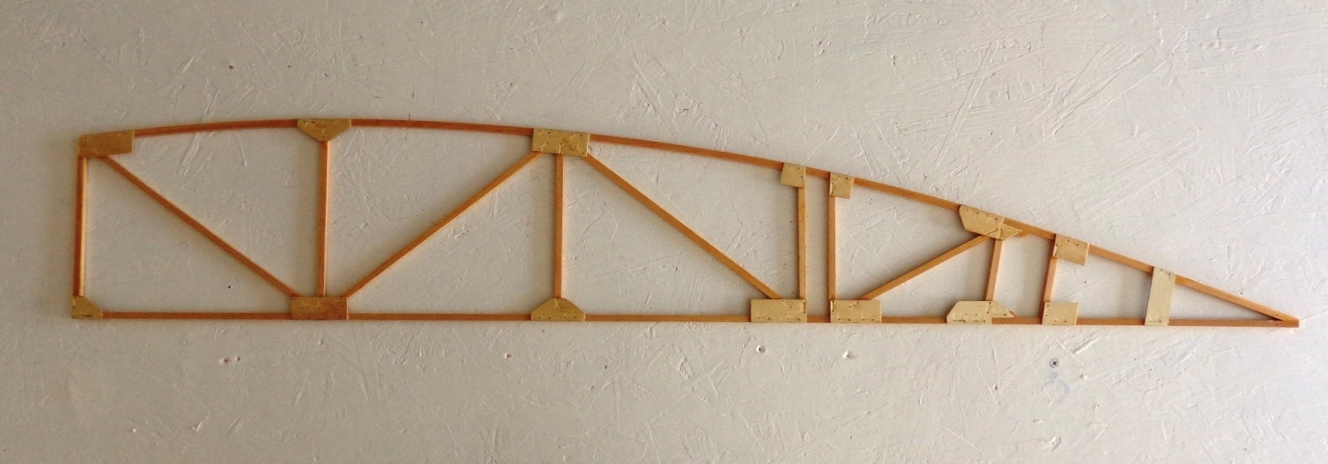
Weight of completed rib :
3.85 oz ( 109 grams )
This is weight of a rib built for Max 103 with 1.5 mm gussets cut to weight-saving pattern as in picture.
( not applicable to the 6 special purpose ribs )
aeronutMarch 29, 2017, 10:13pm
Variation in wood weight is to expected. As the tree grows the density of the wood will vary between seasons ( spring and summer vs fall and winter) and also regarding if the tree was open grown or was grown under shade. All of this occurs in the same species and also varies within the tree. Most of the parts within the ribs are Northern White Pine and as the tree grows it grows at different rates, some times due to climate or other stress on the tree. The slower the growth the more dense the wood. It is difficult today to reproduce the conditions that the old growth Sitka Spruce grew in prior to our intervention with logging. The primary emphases in forestry today is fast growth and that is at odds with the quality that we are looking for. I am not saying that logging is a bad thing but as a forest manager most of our goals are to provide an income to the forest landowner. Even the Northern White Pine second growth wood is getting younger at harvest and thus more difficult to find in the grade that we seek. Wood is a fantastic natural composite material.
never surrender; never give-up
TomMarch 29, 2017, 10:36pm
Amen, Aeronut,
You have to go to carbon fiber based composites to have a hope of getting lighter structures than wood/epoxy for a given structure in anything like an aircraft or a boat.
I will say in my opinion you are best concentrating on the average weights of given structural materials, coatings per coat, etc. and then carefully calculating the weight for each individual item and coat. Go into the greatest possible detail and you'll come amazingly close to actual weight as the errors in a detailed carefully done calculation cancel out.
Tom
Keith103March 30, 2017, 2:50pm
Quoted from aeronut
Variation in wood weight is to expected. As the tree grows the density of the wood will vary between seasons ( spring and summer vs fall and winter) and also regarding if the tree was open grown or was grown under shade. All of this occurs in the same species and also varies within the tree. Most of the parts within the ribs are Northern White Pine and as the tree grows it grows at different rates, some times due to climate or other stress on the tree. The slower the growth the more dense the wood. It is difficult today to reproduce the conditions that the old growth Sitka Spruce grew in prior to our intervention with logging. The primary emphases in forestry today is fast growth and that is at odds with the quality that we are looking for. I am not saying that logging is a bad thing but as a forest manager most of our goals are to provide an income to the forest landowner. Even the Northern White Pine second growth wood is getting younger at harvest and thus more difficult to find in the grade that we seek. Wood is a fantastic natural composite material.
Thanks Aeronut, for this interesting contextual insight into forestry and where our requirements as airplane builders fit in.
Keith103March 7, 2018, 2:33am
Here is an update, as I had just finished working on putting together the complete tail unit last week, for Max 103 with light tail.
Horizontal stabilizer ( light build for Pt 103 )
After varnishing: 3.78 lb , 60.48 oz, or 1715 gms
( Note: with tail strut receiving brackets, and 3 light hinges installed, but not yet covered with fabric . The strut is not included.)
Elevator ( light build for Pt 103 )
After varnishing: 2.872 lb , 45.95 oz, or 1303 gms
( Note: with light hinges (3) and elevator horn installed, but not covered with fabric )
Rudder
After varnishing 1.526 lb 24.42 oz 692 gms
( with hinges and horn , fully varnished, not covered with dacron )
Vert stab ( Fin )
After varnishing 1.632 lb 26.09 oz 740 gms
( with hinges and strut bracket , fully varnished, not covered with dacron )
Total tail weight for Light build for Pt 103:
( Fabric and strut tubes excluded )
9.81 lbs ( 156.94 oz ) or 4.45 kgs
Keith103March 14, 2018, 4:23am
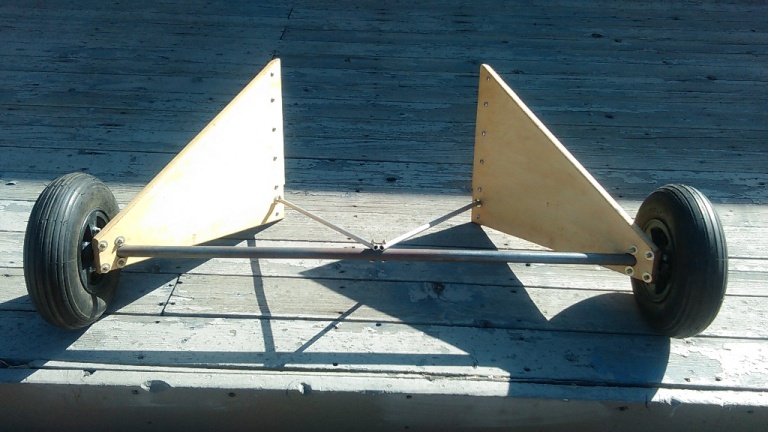
I got some weights for the Ultralight Mini-Max 103:
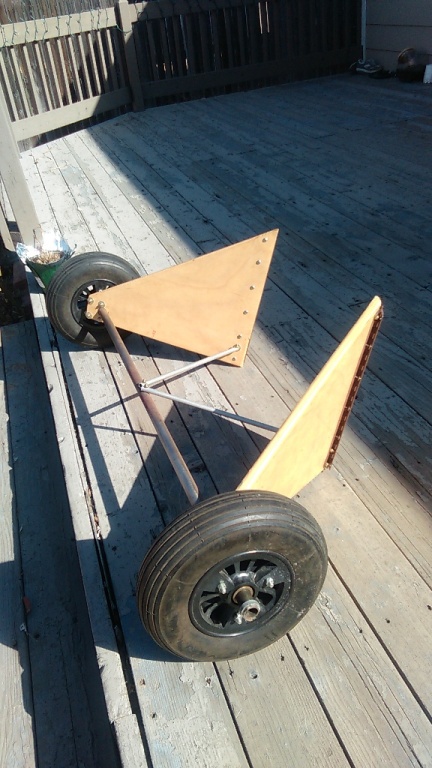
Landing gear:
( as shown in picture; The wheels came with kit & have plastic hub.)
Has no brakes or brake fittings:
===
Total
17.7 lbs:
Breakdown:
Steel Axle for Narrow width fuselage ( 56 inch length )
4.2 lbs
2 wheels with plastic hub & tires
4.15 lb each
Total for 2 = 8.3 lbs
The wooden gear legs with Aluminum pipe attachment to the axle: ( with full length hinge)
2.6 lb each (per side)
Total for 2 sides= 5.2 lbs
raphael150March 23, 2018, 6:12pm
I fininshed all 4 wing spars and the weight of all together is around 19.84 pounds. Could someone say if it is ok, heavy, light...?! I would like to know because I am using Brazilian aircraft wood called freijó.
Thank you
Keith103March 23, 2018, 8:44pm
Some weights I had checked when I built the spars:
( weight will vary by model, my wing is the ultralight version )
I weighed only the right side spars, but left side also should be close.
Front spar ( without metal hardware ):
4.825 lbs ( 2.188 kg )
Rear spar ( without metal hardware ):
4.350 lbs ( 1.973 kg )
Weight of 4 spars = 18.35 lbs
Note: I used domestic birch plywood 1.5 mm for spar web.
Finnish birch ply would have been slightly lighter.
The spar caps were from sitka spruce, and came with Team's kit.
Weights of spar caps ( each 142 inches long before assembly ) ranged from 15.11 oz to 20.14 oz.
Variation in weight was partly differences in tree stock, and also partly because all caps are not of exact same dimension.
There were very slight differences in thickness ( cross section ), but since each piece is very long, these slight differences
in width can translate to almost 25 % difference in weight.
Following were weights of spar caps:
15.11 oz ( 428 gms )
16.40 oz ( 465 gms)
18.64 oz 9 529 gms )
18.85 oz ( 534 gms )
19.08 oz ( 541 gms )
19.79 oz ( 561 gms )
19.83 oz ( 562 gms )
20.14 oz ( 571 gms )
I used the heaviest 4 spar caps for the front spar.
Good thing I weighed them before assembly, otherwise I could never have guessed.
raphael150March 25, 2018, 1:54am
Thank you very much, Keith!
Mine is in a average!
Keith103June 2, 2018, 6:03pm
Weight of covering with dacron / Ceconite fabric:
-----
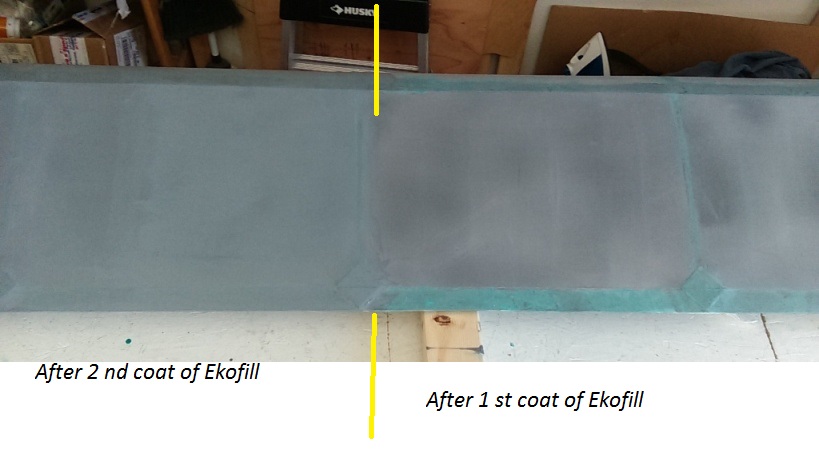
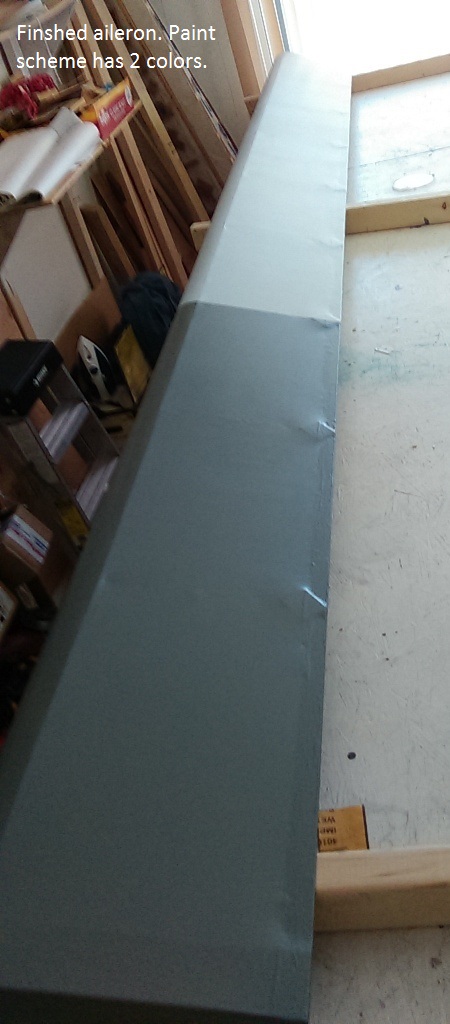
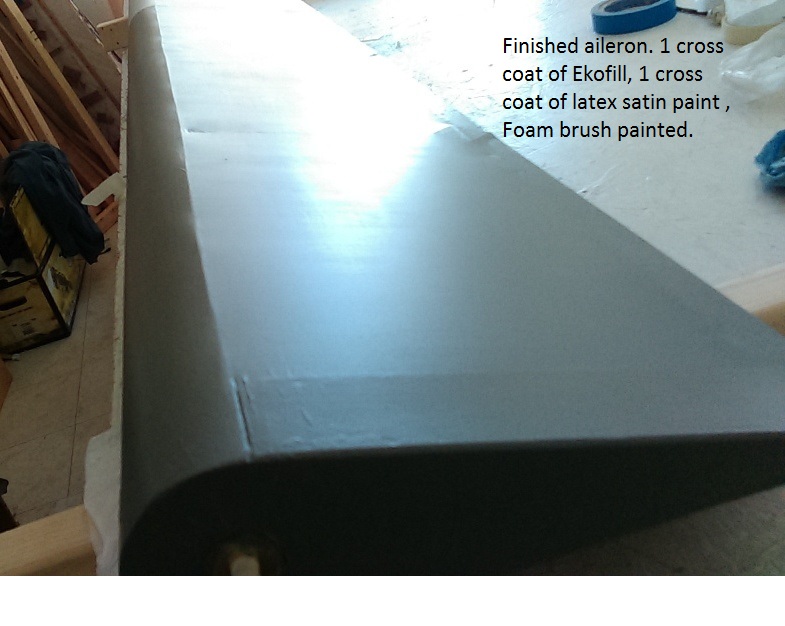
I just finished covering and painting of ailerons. Some findings as below:
===
Weight of aileron before covering, with aileron horn and other hinge hardware installed:
74.4 oz - 4 lbs 10.4 oz ( 2109 gms )
===
Weight after covering with fabric: ( + 7.2 oz / 205 gms)
81.6 oz - 5 lbs 1.6 oz - (2314 gms)
===
Weight after one cross coat of Ecofill primer from Stewart systems which has UV blocking properties : ( + 2.5 oz / 71 gms)
84.1 oz - 5 lbs 4.1 oz - (2385 gms)
===
Weight after 1 cross coat of Exterior Latex paint: ( + 1.2 oz / 33 gms )
85.3 oz - 5 lbs 5.3 oz - ( 2418 gms )
===
My aileron has a surface area of 26 sq feet.
And net weight addition for Dacron + Ekofill + latex paint was 10.9 oz ( 309 gms ).
Therefore if you estimate a total surface area of about 550 sq ft for the entire airplane, then total weight addition from covering and painting will be about 14.41 lb using the abbreviated painting steps that I followed. ( About 9.5 lb just for the weight of dacron + fabric cement , and about 5 lbs for the whole painting process. )
This is not a post about painting or how many coats of paint is necessary or adequate. It is just about the weight of aileron and fabric and how much weight each additional coat of primer and paint adds.
It is seen that weight of Ekofill is more than that of Latex paint for same type of painting process that was used.
Mine is a frugal paint job with some basic UV protection. The main aim being to meet Pt 103 weight constraints.
Keith103June 2, 2018, 6:05pm
(unknown)June 3, 2018, 1:57am
Your fabric glue you used called ekobond is really good stuff. It used to be called cecobond, its water based and held up great on my skypup.
LSaupeJune 5, 2018, 8:57am
Anyone have comparison weights of Oratex? Heard it is supposed to be the lightest system out there (when compared to finished painted products).
Keith103July 6, 2018, 11:05pm
Weight of wings ( Max 103 ):
My left wing came out 31.5 lbs after covering and painting.
Right wing came out 32 lbs after covering and painting.
( Includes weight of aileron, aileron attach hardware, wing to strut attach fitting , and wing to fuselage attach fitting )
The wing was weighed on a bathroom scale, so it is not that accurate, but the numbers give a general idea of what to expect.
I have read somewhere that a good paint job adds anything from 15 to 25 lbs for the entire airplane. My total paint weight is not likely to exceed 7 lbs for entire airplane. So if you are doing regular multi-coat paint job on your plane, then you can expect Max 103 wings to weigh in at about 34 to 36 lbs each.
(The wing-struts, including AN hardware, weighed in at 3.25 lbs per side. This is not included in above weight of wing )
tjtheaviatorJuly 7, 2018, 3:08pm
The aluminum fuselage tank from TEAM weights 4.4 lbs with cap. Not sure how that compares to the old poly tanks.
Keith103July 7, 2018, 5:55pm
Forgot to mention , my Max103 has no wing tanks. Just a 5 gal acrylic tank in front fuselage per plans.
Keith103August 4, 2018, 8:58pm
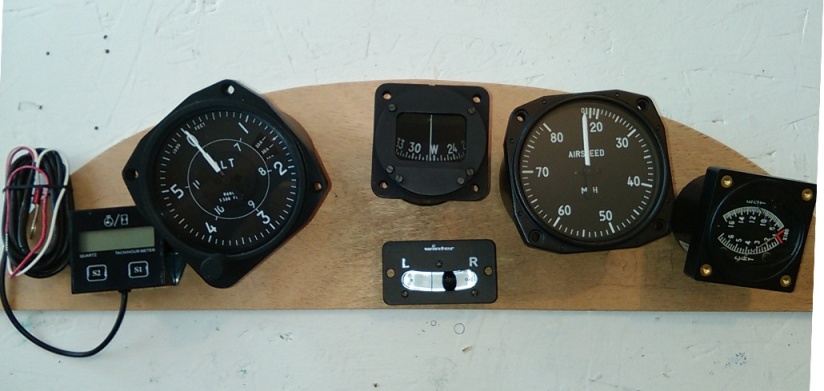
2.8 lbs is the total weight of the 6 instruments in image PLUS the 1/4 fir plywood panel.
Not Included:
Weight of attachment brackets of panel to fuselage.
Attachment bolts/ screws of instruments to panel.
Wires / leads for instruments like EGT CHT
Weight of electrical switches to be mounted on panel.
TomAugust 4, 2018, 10:39pm
On the Oratex weights:
I have a fair amount of data on paint weights and when I cross checked that against the videos the Oratex distributor did comparing samples, I found a good match. If you go to their web site and watch the videos, or look them up on YouTube I believe they are being fully truthful in their tests and the weights that they give for various samples.
Tom
Keith103August 4, 2018, 11:46pm
On second thought, the following weights may actually be more useful to know:
Falcon 3 inch Altimeter 10.32 oz
Falcon 3 inch Air Speed 10.02 oz
Compass 9.40 oz
CHT EGT Combo 2.9 oz
Tiny Tach 1.52 oz
Winter Slip Indicator 1.51 oz
1/4 inch ply panel 7.33 oz