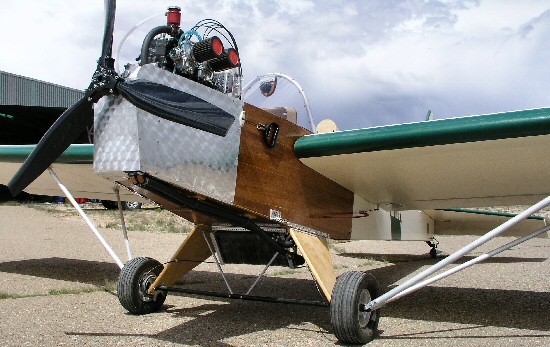
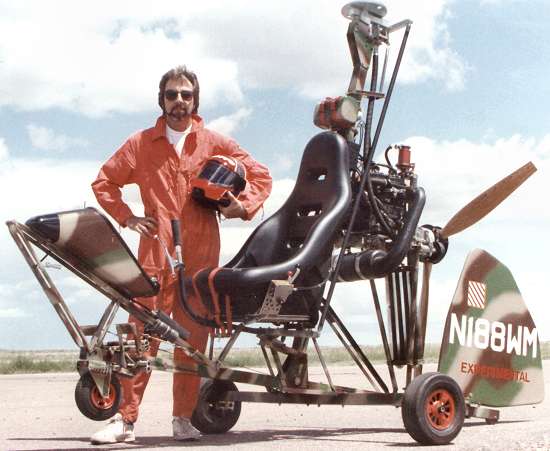
Antoni, A 90 hp water-cooled Suzuki snowmobile engine powered my first EAB aircraft, a kit-built Eagle Gyroplane. In 1988 it offered things other 2-strokes did not, like electronic ignition, oil injection, adjustable main jets, and a Rotax gearbox custom fitted to the engine by the supplier of the engine package (this would almost kill me later when the gearbox partially separated from the engine in flight due to the fabricators failure to drill proper mounting holes in the Suzuki's crankcase). Oddly, because the kit supplied one of the most powerful engines then available for a kit Gyro, it sported the name - "Black Max."
To this point, the only 2-stroke experience I had was with motorcycles. The concept of 90 HP was very appealing, especially on a draggy machine like an open-frame Gyro, and also because I flew from a 7000' elevation. In fact, the engine spent most of it's flight time in the upper 1/4 of the RPM range to overcome the drag (calculated at the time to be equivalent to about 2-square feet of flat plate area), so I had little feeling for how much torque was available at lower RPM ranges. This would turn out to be critical later on my Max.
The engine was indeed powerful at high RPMs, around 8200 stock, as on my Gyro, or up around 10,000 if you were racing it in a snowmobile! I'll never forget the scary thrill that happened every time that engine suddenly ramped up at 7600 RPM and shoved me back into the seat. It made me aware that although flight speed was only around 55 MPH, I was sitting astride a real monster!
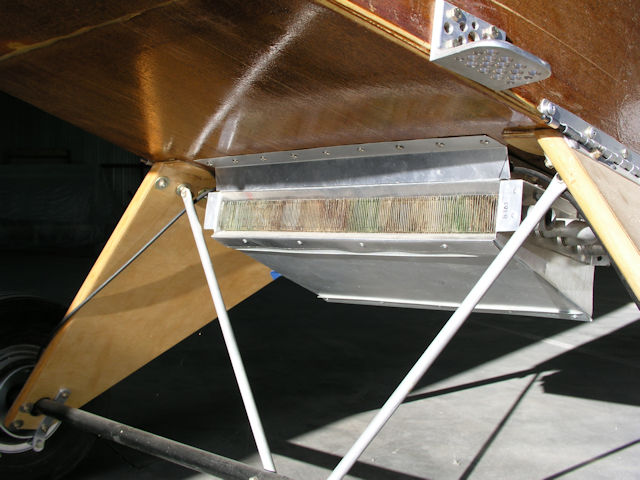
But the major failure of this same engine when installed in my Max was the fact that there was virtually no useful torque available below that 7600 RPM point. This made operation in an airplane virtually impossible because it became, essentially, a power-on/power-off situation. Yeah...akin to a Sopwith Camel! Even with the theoretical power available, I only made two test trips around the pattern, barely able to remain airborne and get back around to the runway. I never really understood why, but in retrospect I figured the relatively small prop disc just wasn't able to provide sufficient thrust - likely proving that my Max had even more drag than the Gyroplane! The end of that story came when, in spite of the water cooling, and a gorgeous hand-fabricated radiator, which I was very proud of, and was one of the most complex components I ever fitted to my Max - I cooked both pistons! Probably during one of my many ground tests. Thus, after 18 years of construction, I ended up having to swap out the Suzuki for the 503 (and deal with the FAA again) before I ended up with a flyable airplane.
After 8 years of successful Max flying I just recently pulled the plug and decided to quit flying. There were many reasons. Two main reasons were that my deteriorated age-related vision was becoming a concern, and I was also conscious, as wear began showing up in several components, that parts of this airframe were now 28 years old. I had begun to think a lot about those epoxy joints! The final impetus though occurred during my last flight.
I was returning to the airport, and was about two miles out when my EGT's suddenly began to climb above the 1200 degree limit. I fully expected that I was going to have to find a place to set her down in the next few seconds! I throttled up full to gain extra cooling and was able to make it through a short, desperate pattern and get it safely on the ground. This was the first time this engine had ever failed me. I was unable to find an obvious cause, and believe the most likely culprit is probably a crankcase or gasket air leak. In any case, it would likely require a tear-down and diagnosis. Combined with the previous decision to make this season my last due to my vision, this was the final blow. I do not have the experience, the tools, or a facility to tackle this myself, and no local Rotax shops are available where I live. I also have no desire to spend what is likely to be a considerable amount of money to repair an engine that I was probably only going to fly for one more summer.
Like most things, this did not pan out the way I was imagining it would. Due to potential liability my Max will not be sold. At this time there is a potential deal in the works for it to spend the rest of it's life hanging from a Museum ceiling as an exhibit. It's a bit sad for me, but it's all part of the acceptance required of aging. The way I see it is that this wonderful little machine, built with my own two hands in a garage, was able to satisfy my dreams of simple flight for more than eight years, and I survived to tell the tale! I'm really a very lucky dude.