Building and Flying Related Boards › miniMax, Hi-Max, and AirBike General Discussions
rib engineering and rib stitching question
30 posts
kfbFebruary 14, 2020, 10:49pm
Hi
Here is a question for persons with mechanical engineering understanding coupled with aeronautical backgrounds and I hope I present it in a way that is not confusing.
On the subject of rib stitching, is there any structural/mechanical advantage to including the bottom rib member in the rib stitching process versus including only the top rib cap in the stitch?
This discussion has arisen as I would like to stitch my Mini Max wings using just the upper rib caps as it somewhat simplifies and speeds up the job versus the traditional loop incorporating the lower rib member
When I look at the suggested stitching diagrams, what I see is that all of the potential upward pull on the rib stitch cord is born by the bottom rib member. I believe that if the cord is not wrapped around the upper rib cap after coming up from the lower rib member, only the bottom member gets the upward pull generated by moving the wing through the air. Now perhaps it is not merely the strength of the bottom member in the case of regular stitching, but rather it is the strength of the total framework (and triangulations) created in the design of the rib. So, by merely running down to the bottom rib member and coming back up, is the full design strength of the rib structure realized, and could one get this same design strength by merely looping around the top rib cap? I am aware that one argument against just the top rib cap might be that more reliance is placed on the integrity of the glue joints in the wing rib structure in comparison to the method of looping around the bottom rib member.
All comments appreciated.
Kim Brown
New Hampshire
PUFFFebruary 17, 2020, 1:16pm
personally, if I were to rib stitch, I would do the whole works, partly for the reason you gave above. However, I'm not an aircraft engineer, so my answer is a moot.
With Rib stitching, I would surmise that even if a rib failed, maybe, just maybe the stitching would hold it together long enough to get back on the ground.
TomFebruary 17, 2020, 5:18pm
Dear Mr. Brown,
While I'm not an expert on rib stitching, I do work with and teach materials science and structural analysis, both in my design work and in the technical school I run. I can tell you this much: These ribs are "trusses". As such they are strongest when the whole truss is included in supporting the load. For instance if you wanted to test the strength of a rib you would normally hang weights that were supported by the entire truss to get the best reading of strength. You would not just hang the weights from the bottom member. So you should get more strength if the entire rib supports the stitching rather than just one element of the rib truss. How much difference that would make however would require real world testing and careful defining of all the variables.
Sincerely,
Tom
kfbFebruary 17, 2020, 7:24pm
Tom
Thanks for your input, another option I suppose would be some combination of top only stitches and also some number of full rib stitches mixed in. I have gotten feedback from one Max owner with a few hundred hours on a top only build, and a response from the owner of the Mini Max line who believes top only is adequate.
Kim Brown
radfordcFebruary 18, 2020, 1:21am
My Airbike flew for several years with no rib stitching and no problems noted.
I suspect that rib stitching doesn't mean very much for a plane like the Minimax.
StilsonFebruary 18, 2020, 4:11am
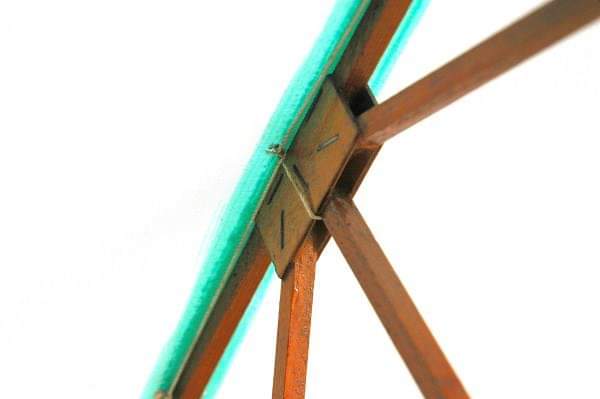
I'm not an engineer, but.. I restored a set of wings that had 1100 hours on them, the fabric was still good, it had always been stored inside, I installed inspection rings at all of the diagonal drag/anti drag connectionions and thought from out side inspection everything seemed well, light pressure from the inside revieled 4 ribs (fabric glued on only) were no longer attached to the fabric. I rebonded them, and decided to ribstitch both wings for peace ofmind. I found that trying the traditional full depth ribstich tended to distort he capstrip while pulling the knot tight (beech knot), and rationalized that many maxes have, and for 1100 hours this one had relied entirely on bonding to the top strip, so ended up stitching just around the capstrips, be it it right or wrong is up to someone smarter than myself.
toliver66February 18, 2020, 5:08am
The fabric is shrunk tight over the ribs to the point that it dips between the ribs. So in order for the fabric to come loose and lift from the ribs it would first have to pull all the "dip" from between the ribs. The fabric on my wings is so tight that it feels more like a solid surface than stretched fabric. My point is, if the fabric has come loose and lifted from the ribs then I have suffered a catastrophic structural failure and loose fabric is the least of my problems at the moment. It has been well proven over the years that a minimax does not require rib stitching. So to rib stitch or not to rib stitch, regardless of how you do it, is irrelevant as it makes no difference. So if rib stitching gives you peace of mind, then by all mean rib stitch the hell out of it. But all you are really doing is adding dead weight. Larry Israel from the old Team Minimax fabric covering video says as much in the video.
StilsonFebruary 18, 2020, 5:44am
It gives me peace of mind knowing that a wingtip birdstike or other unfortunate event might stop at being a drag brake that my controls can overcome rather than fully skinning the wing. Peel strength alone of a 1/4" glued joint with even a small piece of fabric flagging is out of my comfort level when a few ounces, maybe a pound of thread and tapes makes the difference. I'll skip breakfast to make up the difference in exchange for piece of mind.
PUFFFebruary 18, 2020, 12:41pm
Agree with Stilson. My bird wasn't rib stitched, but I had always wished it was.
toliver66February 18, 2020, 11:46pm
To each his own, whatever helps you sleep at night. A bird strike is highly unlikely in any event. But if it makes you feel any better, then by all means, rib stitch away.
StilsonFebruary 19, 2020, 12:27am
I live in pheasant country with tall grass on three sides of the runway, and also will never forget the day I was practicing turns on a point and at 3500 ft agl had a red tail hawk try to take me down, first time I thought that was close, second time, I thought what the heck is he doing, third time it became apparent, he was trying to take on the aeronca champ I was in, no doubt in my mind, he was intentionally trying to dive strike my wing. I had to abandon the area, in the champ I could out run him, had I been in my max I don't know.. I might have taken atleast a large fabric slice from him while disengaging, weird stuff happens. At the time I would have never thought a hawk flys that high, and disbelief of what was happening almost got me in trouble, if you've ever seen a black bird harassing a hawk, the way they try to pull there feathers out, he was trying the same tactic on the champ. Life is stranger than fiction sometimes.
(Edit: another lesson, it you see a bird of prey in the area, don't linger there, and definitely don't let them gain an altitude advantage, if it can dive on you and gain a speed advantage it will out turn you and they are extremely good "pilots")
toliver66February 19, 2020, 1:57am
Quoted from Stilson
I live in pheasant country with tall grass on three sides of the runway, and also will never forget the day I was practicing turns on a point and at 3500 ft agl had a red tail hawk try to take me down, first time I thought that was close, second time, I thought what the heck is he doing, third time it became apparent, he was trying to take on the aeronca champ I was in, no doubt in my mind, he was intentionally trying to dive strike my wing. I had to abandon the area, in the champ I could out run him, had I been in my max I don't know.. I might have taken atleast a large fabric slice from him while disengaging, weird stuff happens. At the time I would have never thought a hawk flys that high, and disbelief of what was happening almost got me in trouble, if you've ever seen a black bird harassing a hawk, the way they try to pull there feathers out, he was trying the same tactic on the champ. Life is stranger than fiction sometimes.
(Edit: another lesson, it you see a bird of prey in the area, don't linger there, and definitely don't let them gain an altitude advantage, if it can dive on you and gain a speed advantage it will out turn you and they are extremely good "pilots")
I stand corrected. Thank you for the interesting story. Now that you mention it, I do recall seeing several videos on Youtube about birds attacking ultralights.
PUFFFebruary 19, 2020, 1:18pm
If I remember correctly there was a MiniMax attacked the same way a few years ago, and the pilot had to put it down in a field with full aileron deflection to keep it flying enough to land. Apparently the hawk went thru the wing between ribs. I think I would have caught that hawk after that, painted a swastika on it and kept it as a pet...
StilsonFebruary 22, 2020, 2:10am
Quoted from PUFF
If I remember correctly there was a MiniMax attacked the same way a few years ago, and the pilot had to put it down in a field with full aileron deflection to keep it flying enough to land. Apparently the hawk went thru the wing between ribs. I think I would have caught that hawk after that, painted a swastika on it and kept it as a pet...
Or atleast an iron cross and and spiked hood, that bird would definitely qualify as a hun ☠️, I personally will consider them enemy combatants (I apologize for the thread drift, though in a way I believe it to be relevant).
Bob DalyFebruary 22, 2020, 2:58pm
Quoted from kfb
Hi
Here is a question for persons with mechanical engineering understanding coupled with aeronautical backgrounds and I hope I present it in a way that is not confusing.
On the subject of rib stitching, is there any structural/mechanical advantage to including the bottom rib member in the rib stitching process versus including only the top rib cap in the stitch?
This discussion has arisen as I would like to stitch my Mini Max wings using just the upper rib caps as it somewhat simplifies and speeds up the job versus the traditional loop incorporating the lower rib member
When I look at the suggested stitching diagrams, what I see is that all of the potential upward pull on the rib stitch cord is born by the bottom rib member. I believe that if the cord is not wrapped around the upper rib cap after coming up from the lower rib member, only the bottom member gets the upward pull generated by moving the wing through the air. Now perhaps it is not merely the strength of the bottom member in the case of regular stitching, but rather it is the strength of the total framework (and triangulations) created in the design of the rib. So, by merely running down to the bottom rib member and coming back up, is the full design strength of the rib structure realized, and could one get this same design strength by merely looping around the top rib cap? I am aware that one argument against just the top rib cap might be that more reliance is placed on the integrity of the glue joints in the wing rib structure in comparison to the method of looping around the bottom rib member.
All comments appreciated.
Kim Brown
New Hampshire
My take on this is:
1) The rib stitching doesn't pick up any loading until the glue has given up. Then while the glue is doing the work, most of the load flows into the upper rib cap.
2) The air pressure on the lower wing surface is upward for all positive loading flight regimes given the flat-bottomed airfoil.
3) The rib is a truss which implies that all the member loads are axial but the chord members are also loaded in bending.
4) I believe that the chord sections between nodes can be analyzed as simple beams. Then for a given section, the beam formulas apply and depending upon where the stitches are positioned, bending can be estimated.
This is complicated further because the chord-wise lift distribution is not at all uniform. However, given (1) and (2) above, and appropriately located stitches, stitching only to the top rib cap is a reasonable proposition.
StilsonFebruary 22, 2020, 6:25pm
Quoted from Bob Daly
2) The air pressure on the lower wing surface is upward for all positive loading flight regimes given the flat-bottomed airfoil.
I have read some conflicting studies on this, some stating the the difference in relative velocity between the air inside of the wing and the air outside of the wing creates a pressure difference that actually results in a downward force on the bottom wing skin but the net force of the top and bottom of the wing as whole results in lift. I seem to remember also some studying done on venting the internal chambers of wing to a low pressure region of the wing to negate this. Though at buzzard speed it's probably negligible.
There is some naca guidelines on stitch placement recommendations based on wing loading, vne, and location (in or out of slipstream etc) that give a good baseline without doing all the calculations.
kfbFebruary 23, 2020, 3:22am
Hi
I am going ahead with top only stitches, will adhere to the suggested spacings, and am not using glue. Were I to choose to do the glue too, I probably would see if Hypec is still around and use their product, thanks for all comments.
Kim Brown
radfordcFebruary 23, 2020, 3:43pm
What benefit is there to not gluing the fabric to the rib? Is there a downside to using both glue and stitching?
TomFebruary 23, 2020, 5:47pm
Dear kfb,
The rib stitching is a "backup" to get you home if the glue fails. Please use glue.
Tom
Bob DalyFebruary 23, 2020, 8:59pm
Quoted from Stilson
I have read some conflicting studies on this, some stating the the difference in relative velocity between the air inside of the wing and the air outside of the wing creates a pressure difference that actually results in a downward force on the bottom wing skin but the net force of the top and bottom of the wing as whole results in lift. I seem to remember also some studying done on venting the internal chambers of wing to a low pressure region of the wing to negate this. Though at buzzard speed it's probably negligible.
There is some naca guidelines on stitch placement recommendations based on wing loading, vne, and location (in or out of slipstream etc) that give a good baseline without doing all the calculations.
Me too. Especially Tom Rhodes' "Stress Without Tears" which does a very good description of "diaphragm loading" to explain how fabric covered wings take air pressure loads into the ribs. He says the bottom fabric has a downward pull but I think that is owing at least in part to the semi-symmetrical airfoil in his example. With a flat-bottom airfoil, there is no negative camber to the bottom surface to help create a reduced free stream pressure. And the Minimax/Himax wing is not usually completely enclosed then the air pressure inside might equalize somewhat.
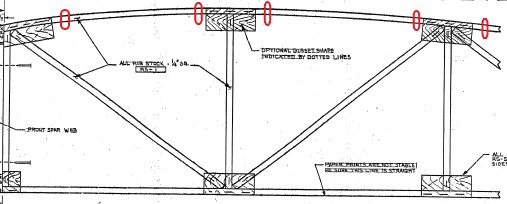
If we wanted to avoid bending stress in the rib truss chords (the rib caps), the rib stitches should be on or very near the nodes (the clusters of the diagonals and verticals). I would put stitches around the top rib cap like so:
aeronutFebruary 23, 2020, 10:06pm
You need a pad under the rib stitching then a tape to go over that. I rib stitched on the initial build of my Minimax and glued the fabric to the ribs. I am in the process of recovering the wings and I will not rib stitch this time. A friend built a Himax at about the same time period and registered it experimental cause it was way over 254# had two wing tanks and electric start and a battery and our airplanes cruised and climbed muchly the same. His fabric never moved with only the glue. We both have 447's in the airplanes.He also has a lot more time on his airplane than I do. I am not trying to say that you should or should not rib stitch; just my experience. The airplanes are twenty years old.
never surrender; never give-up
StilsonFebruary 23, 2020, 11:33pm
I would not in any way ever consider only stitching, as stated it is a safety in the event the glue fails. I strongly recommend poly tac and polybrush because it has a strong history of working and I have personal experience with it. I'm planning on trying the stewart system on my current build (the solvents in the stits system are pretty strong) and from what I've heard it works good, but I've not had personal experience with it yet.
(And I read "stress without tears" many years ago, it may have imprinted from that,but i also remember a few of the the old naca files addressed it, though details of influences from camber and profile are fuzzy from time)
Bob DalyFebruary 24, 2020, 12:08am
One must use glue. The glue ensures the load is distributed over the rib cap. A distributed load will have a much lower maximum bending moment than a single or set of concentrated loads (stitches).
StilsonFebruary 24, 2020, 12:56am
Quoted from Bob Daly
One must use glue. The glue ensures the load is distributed over the rib cap. A distributed load will have a much lower maximum bending moment than a single or set of concentrated loads (stitches).
Agreed x20 absolutely a must
PUFFFebruary 24, 2020, 1:04pm
Quoted from Stilson
Agreed x20 absolutely a must
ad +20 more for me..... GLUE FIRST!!!!!!
PhilFebruary 27, 2020, 8:57am
My max was glued before stitching at 4" interval but only in upper camber.
Construction manual did not mentioned rib stitch but I've done for peace of mind.
bob.hoodFebruary 27, 2020, 11:20am
Ace,
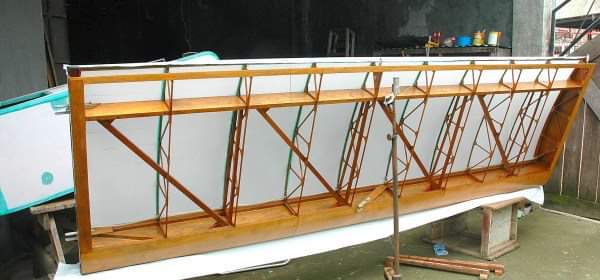
Interesting photos of your wing. The good thing about stitching just the top of each rib before you cover the bottom of the wing is that when you do the stitches, you can make sure the knots are all inside the wing rather than on the top of the fabric.
kfbFebruary 28, 2020, 4:07am
I sure wish I had seen that photo of the wing with fabric on one side only so stitching could be done super easily several months ago, I would have done it that way in a heart beat. It never ceases to amaze me the things I don't think of at the time. Genius at work being demonstrated there. Keep up the good work
Kim Brown
Bob DalyFebruary 28, 2020, 7:40pm
So let's take a whack at analyzing our rib. Because we have data for point A on the flight envelope and it is likely a design case for the rib that's what we'll investigate. What we need is the chordwise load distribution on the wing. Here's a cool toy:
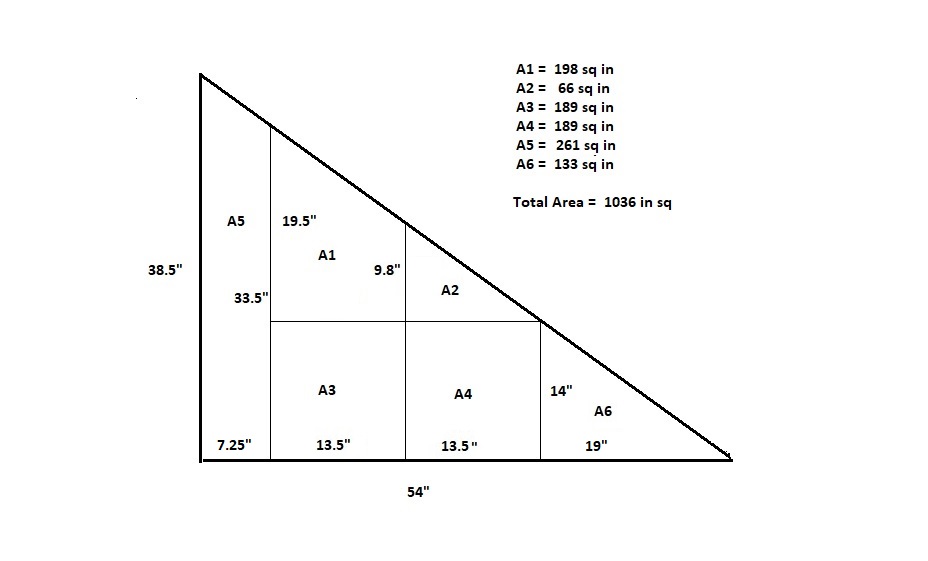
https://demonstrations.wolfram.com/PotentialFlowOverANACAFourDigitAirfoil/ Playing with that or googling or as suggested in "Stress Without Tears" by Tom Rhodes, the load distribution at high alpha on a wing with a NACA 4414 or similar airfoil might be represented simply by a right triangle with the highest load at the leading edge and tapering to the trailing edge. Then we can draw a triangle with the base equal to the wing chord and the area equal to the total normal force looking something like this:
Bob DalyFebruary 28, 2020, 11:06pm
The triangle loading somewhat overstates the load for the rib truss making our analysis conservative.
Area 5 is the load on the D cell. Area 6 is the load aft of the rear spar. Areas 1-4 are the load on the wing between the spars. Each square inch is a pound of force. Then the total force on the wing between the spars is 642 lbs. From our Schrenk approximation, the load coefficients around the inboard most rib with the highest loading are 0.0142 x 4 + 0.0141 x 4 = 0.1132. Then the load on the rib truss is 0.1132 x 642 = 73 lbs.