bob.hoodAugust 7, 2021, 2:41pm
Hello all,
I sadly have to report that my 'max has suffered a fairly terminal event. It's a UK built 88 model, which is like a cross between the US 1030 and 1100 models, but with some additions that were mandated by the LAA (Liight Aircraft Association, formerly known as the PFA or Popular Flying Association). As such the plane has a redesigned anchor point for the shoulder straps, heavier teleflex cables all round, and twin elevator teleflexes. It also has the light tail and light wings from the 1030 and the short narrow fuselage (20") as opposed to the later UK 91 model which uses the heavy wing and tail, and has the 23" wide longer fuselage. Because of these changes the 88 model has a VNE of 90mph instead of the 100mph of the later 91 model.
The plane is powered by a Rotax 447 engine that has a single CDI ignition system, and a single coil that fires both spark plugs using the 'wasted spark' idea.
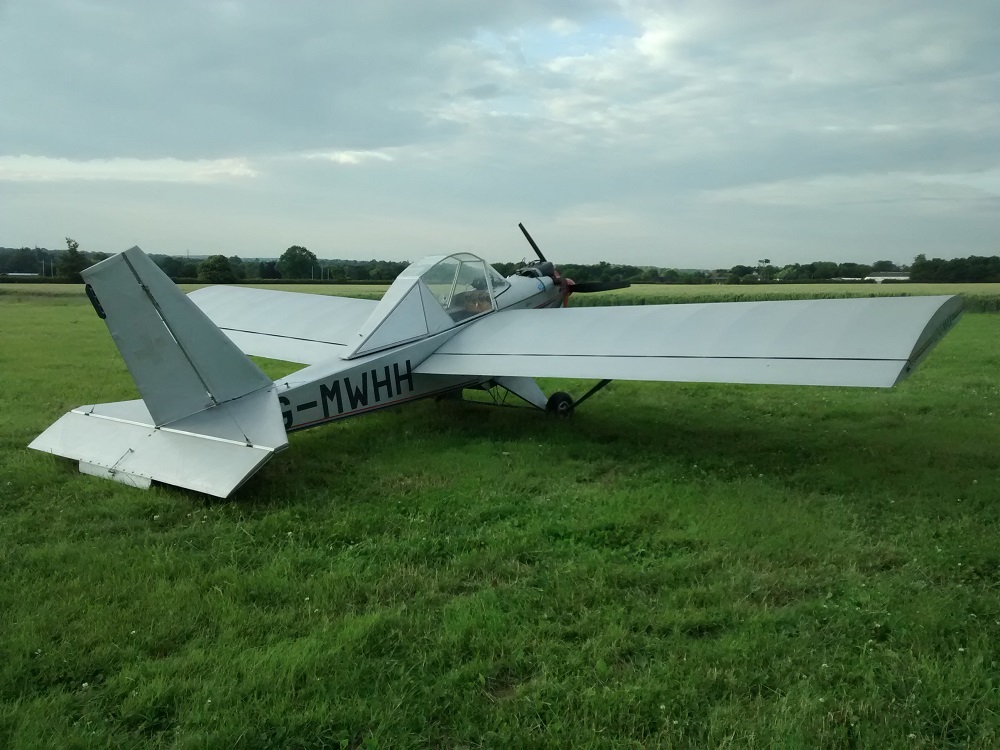
I've attached some recent photos showing the plane as it was prior to Wednesday August 4th. You may notice that it has a sliding canopy, which is both a blessing and a curse in operation, and has some bearing on what happened when I crashed the plane on Wednesday evening.
I was out for a flight around our local area, and had flown around 5 miles away from the field, then turned and was returning to overfly our microlight club field, then I intended to fly around the local city, which is quite small in size. However, as I was travelling along at around 1200 AGL and 55mph, the engine suddenly stopped firing. I didn't know if it was a fuel problem, so started the electric pump (the plane has both vacuum and electric pumps) and hit the starter button repeatedly (it also has an M5 electric starter on it) but the engine didn't fire once. So I headed for our field to try and get back to our runway if I could.
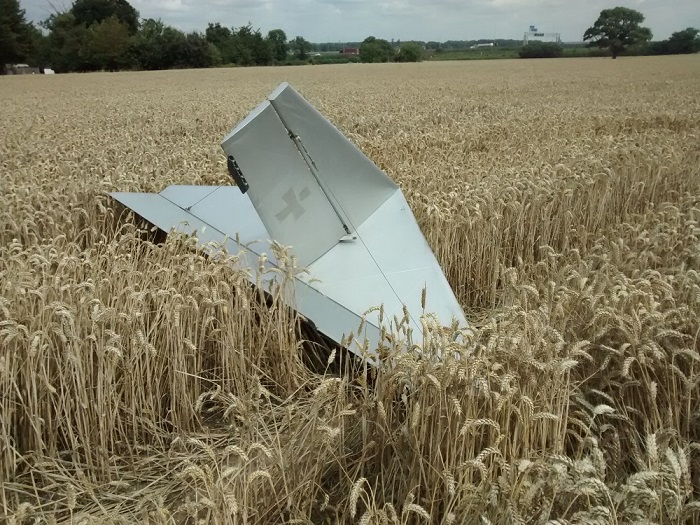
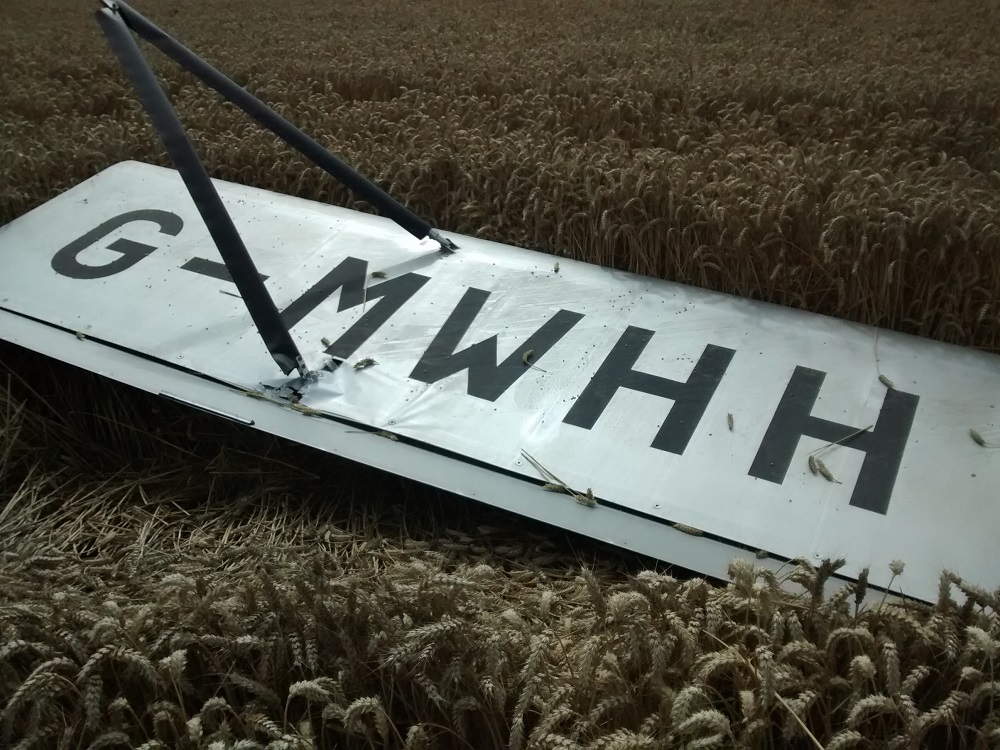
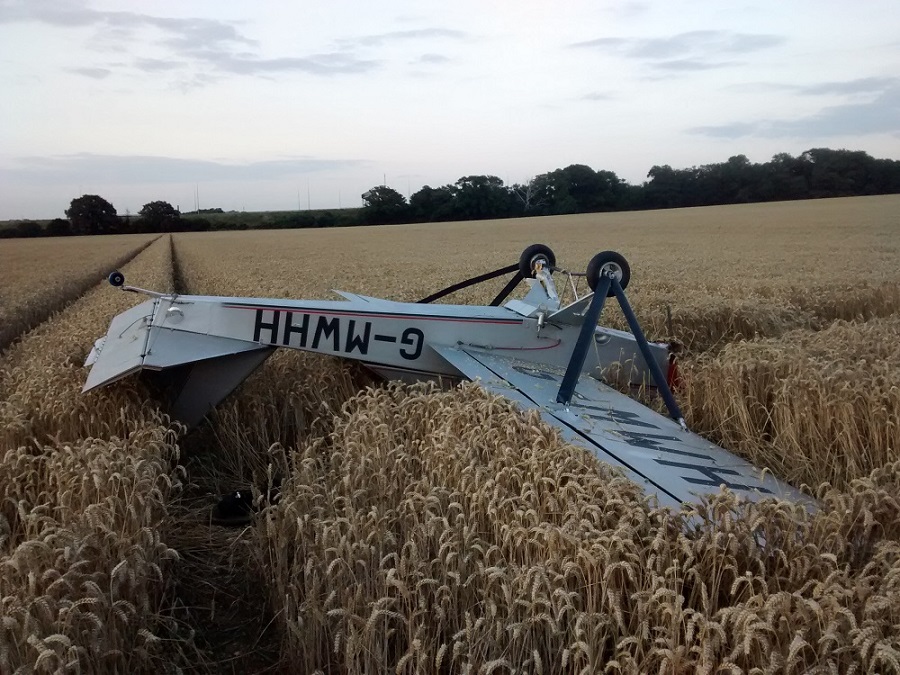
I set the glide speed at around 55mph and tried to glide the mile or so to the runway, as all the fields around our area are currently under a 2ft high wheat crop, including our field (apart from the runway that is). Despite my best efforts I realised I wasn't going to make it over a line of trees to our field, so elected to land in the crop in the next field, and as close as I could get it to the gate in the corner of the field. At around 100ft I turned everything off, then concentrated on keeping the wings level as the aircraft lost height and speed, and tried to flare at around 35 - 40mph when less than 10ft above the crop. The aircraft flared slightly, but then the axle hit the top of the crop and dragged the plane down. The nose hit the ground and flipped the plane upside down, and the tail fin took most of the impact.
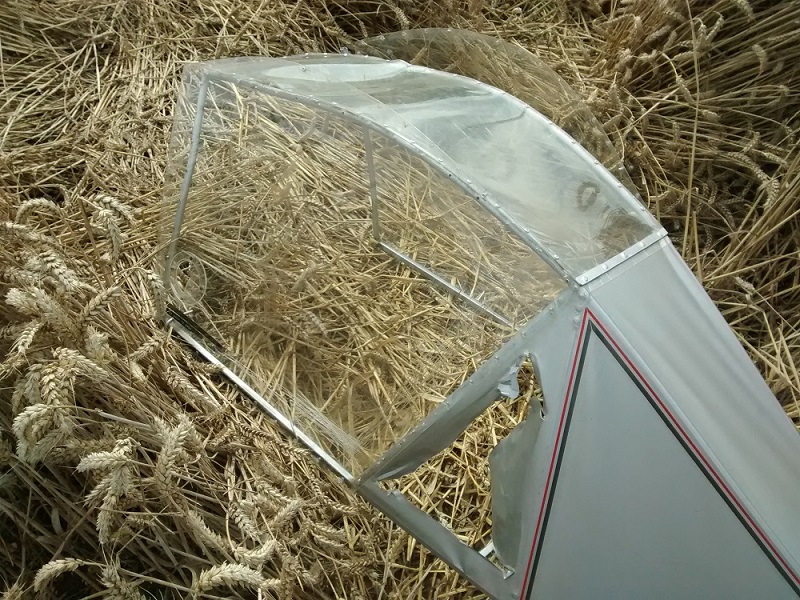
I was left hanging in the seat belt and shoulder straps, but soon undid those and lowered myself so that I was lying on my back inside the sliding canopy roof. I then discovered that the builder had made the side windows of the canopy almost crash proof because I couldn't force the panels away from the metal frame. The panels were rivetted to the frame, and I found I didn't have enough room to turn sideways in the cockpit and push out the window. However, my luck was in because I landed around 100ft from a road next to some horse stables and paddocks, and one of the horse owners, a lady called Marcia, came over to see if she could help. When I told her of my predicament she went away and came back with a claw hammer. By this time I'd managed to break the fabric on one side of the canopy, that covered in the side area behind each of the side windows, so she passed me the hammer and I was able to use the claw part to break the rivets and open the rear seam of the window and crawl out.
Apart from some abrasions on both arms and legs, and some incipient bruises, I seem to be alright, although I'm taking things steady for the next few days, till all the bruises come out.
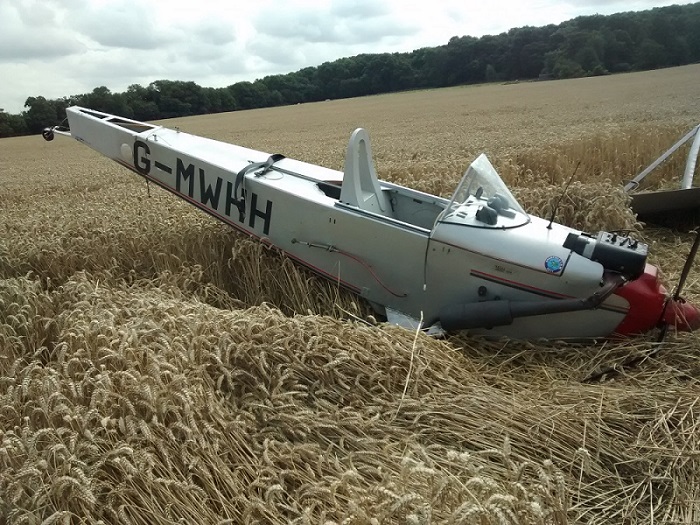
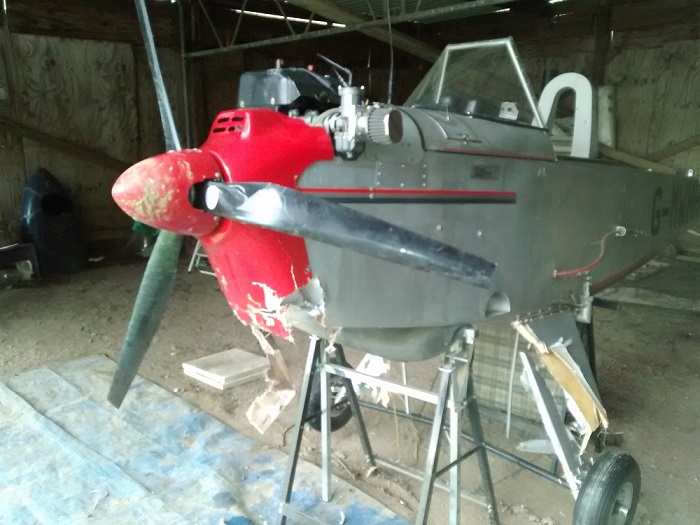
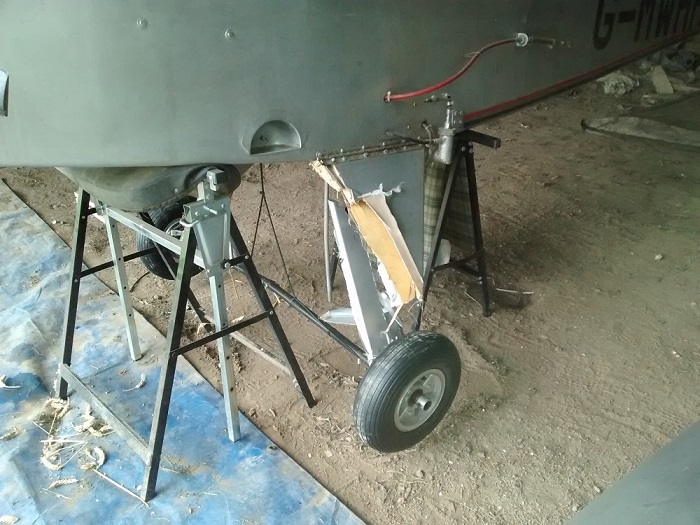
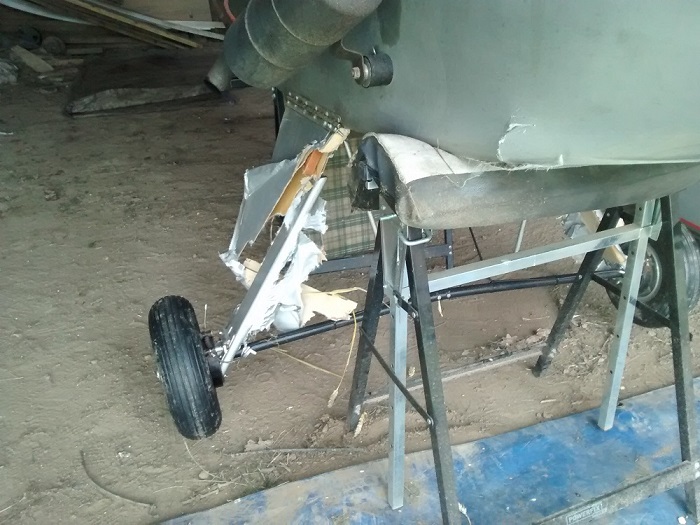
I took some photos on my phone camera, then left the plane there till the next day, when some of our club members helped me remove the wings and tail feathers, then lift the fuselage onto the top of the grass cutter on the back of our club tractor. With this we managed to slowly get all the pieces back to my hangar, and the plane is now sitting there till I decide what to do with it. Both wings suffered fractures of the rear spar, and all four struts were bent. So was the axle, and both suspension legs broke from the impact.
I took more photos as the plane was dismantled, and in one of them you can see what I had to do to the canopy in order to get out. Surprisingly the canopy wasn't badly damaged, and the front screen and frame seem to have been completely untouched, but this may have something to do with the built in roll over bar the builder built into it when he built it back in 1992.
Strong planes Minimaxes, as I can attest to, and even though the front of the plane looks to be a mess, I think that once I've taken off the front fibreglass fairing and removed the broken Ivoprop and spinner, the underlying damage won't be as severe as it first appears. The undercarriage legs will need total replacement, as will the axle and struts, but from what I've seen of the fin and tailplane the structure appears solid. I'll strip all covering off the whole airframe to check, but the main part of the fuselage seems quite solid. The wings though will definitely need either major surgery or replacement before the plane flies again.
As to the engine and what caused it to stop? I strongly suspect that it was my doing. I spent some time on Wednesday afternoon with the dashboard out while I changed one of the gauges, and I strongly suspect that somehow when I put it back in, another wire must have been routed too closely to the back of the mag switch. Flying around for 15 minutes or so allowed the wire to fall against the back of the switch and short out the mag, thus killing the engine. I'll find out for sure when I take the dashboard out again and check all the electrical wiring behind it, but that's my initial suspicion.
As the engine wasn't turning and the prop was stationary when I hit the crop, the crankshaft won't have suffered any shock loading, although I may remove the gearbox and get that checked out. However, once I've given it a good going over I'll see if I can start it again, and I feel pretty certain it'll either show some sparks at the plugs, or be totally dead electrically. Either way I won't be flying behind that engine again. I'm going to re-engine the plane with a water cooled Rotax 462 that has points, because these have 2 coils that can be earthed separately. So if one coil is accidentally earthed the other one will still fire and keep the plane flying a little longer. If I'd had a 462 on the plane when it stopped, it would have just dropped to 1 cylinder and I'd have made it back to our runway without problems, but as it was I now have a very bent aircraft to mend.
Ho Hum, such is life!
Because of the limitations on attachments I'll add some more photos to separate posts below this one.
I sadly have to report that my 'max has suffered a fairly terminal event. It's a UK built 88 model, which is like a cross between the US 1030 and 1100 models, but with some additions that were mandated by the LAA (Liight Aircraft Association, formerly known as the PFA or Popular Flying Association). As such the plane has a redesigned anchor point for the shoulder straps, heavier teleflex cables all round, and twin elevator teleflexes. It also has the light tail and light wings from the 1030 and the short narrow fuselage (20") as opposed to the later UK 91 model which uses the heavy wing and tail, and has the 23" wide longer fuselage. Because of these changes the 88 model has a VNE of 90mph instead of the 100mph of the later 91 model.
The plane is powered by a Rotax 447 engine that has a single CDI ignition system, and a single coil that fires both spark plugs using the 'wasted spark' idea.
I've attached some recent photos showing the plane as it was prior to Wednesday August 4th. You may notice that it has a sliding canopy, which is both a blessing and a curse in operation, and has some bearing on what happened when I crashed the plane on Wednesday evening.
I was out for a flight around our local area, and had flown around 5 miles away from the field, then turned and was returning to overfly our microlight club field, then I intended to fly around the local city, which is quite small in size. However, as I was travelling along at around 1200 AGL and 55mph, the engine suddenly stopped firing. I didn't know if it was a fuel problem, so started the electric pump (the plane has both vacuum and electric pumps) and hit the starter button repeatedly (it also has an M5 electric starter on it) but the engine didn't fire once. So I headed for our field to try and get back to our runway if I could.
I set the glide speed at around 55mph and tried to glide the mile or so to the runway, as all the fields around our area are currently under a 2ft high wheat crop, including our field (apart from the runway that is). Despite my best efforts I realised I wasn't going to make it over a line of trees to our field, so elected to land in the crop in the next field, and as close as I could get it to the gate in the corner of the field. At around 100ft I turned everything off, then concentrated on keeping the wings level as the aircraft lost height and speed, and tried to flare at around 35 - 40mph when less than 10ft above the crop. The aircraft flared slightly, but then the axle hit the top of the crop and dragged the plane down. The nose hit the ground and flipped the plane upside down, and the tail fin took most of the impact.
I was left hanging in the seat belt and shoulder straps, but soon undid those and lowered myself so that I was lying on my back inside the sliding canopy roof. I then discovered that the builder had made the side windows of the canopy almost crash proof because I couldn't force the panels away from the metal frame. The panels were rivetted to the frame, and I found I didn't have enough room to turn sideways in the cockpit and push out the window. However, my luck was in because I landed around 100ft from a road next to some horse stables and paddocks, and one of the horse owners, a lady called Marcia, came over to see if she could help. When I told her of my predicament she went away and came back with a claw hammer. By this time I'd managed to break the fabric on one side of the canopy, that covered in the side area behind each of the side windows, so she passed me the hammer and I was able to use the claw part to break the rivets and open the rear seam of the window and crawl out.
Apart from some abrasions on both arms and legs, and some incipient bruises, I seem to be alright, although I'm taking things steady for the next few days, till all the bruises come out.
I took some photos on my phone camera, then left the plane there till the next day, when some of our club members helped me remove the wings and tail feathers, then lift the fuselage onto the top of the grass cutter on the back of our club tractor. With this we managed to slowly get all the pieces back to my hangar, and the plane is now sitting there till I decide what to do with it. Both wings suffered fractures of the rear spar, and all four struts were bent. So was the axle, and both suspension legs broke from the impact.
I took more photos as the plane was dismantled, and in one of them you can see what I had to do to the canopy in order to get out. Surprisingly the canopy wasn't badly damaged, and the front screen and frame seem to have been completely untouched, but this may have something to do with the built in roll over bar the builder built into it when he built it back in 1992.
Strong planes Minimaxes, as I can attest to, and even though the front of the plane looks to be a mess, I think that once I've taken off the front fibreglass fairing and removed the broken Ivoprop and spinner, the underlying damage won't be as severe as it first appears. The undercarriage legs will need total replacement, as will the axle and struts, but from what I've seen of the fin and tailplane the structure appears solid. I'll strip all covering off the whole airframe to check, but the main part of the fuselage seems quite solid. The wings though will definitely need either major surgery or replacement before the plane flies again.
As to the engine and what caused it to stop? I strongly suspect that it was my doing. I spent some time on Wednesday afternoon with the dashboard out while I changed one of the gauges, and I strongly suspect that somehow when I put it back in, another wire must have been routed too closely to the back of the mag switch. Flying around for 15 minutes or so allowed the wire to fall against the back of the switch and short out the mag, thus killing the engine. I'll find out for sure when I take the dashboard out again and check all the electrical wiring behind it, but that's my initial suspicion.
As the engine wasn't turning and the prop was stationary when I hit the crop, the crankshaft won't have suffered any shock loading, although I may remove the gearbox and get that checked out. However, once I've given it a good going over I'll see if I can start it again, and I feel pretty certain it'll either show some sparks at the plugs, or be totally dead electrically. Either way I won't be flying behind that engine again. I'm going to re-engine the plane with a water cooled Rotax 462 that has points, because these have 2 coils that can be earthed separately. So if one coil is accidentally earthed the other one will still fire and keep the plane flying a little longer. If I'd had a 462 on the plane when it stopped, it would have just dropped to 1 cylinder and I'd have made it back to our runway without problems, but as it was I now have a very bent aircraft to mend.
Ho Hum, such is life!
Because of the limitations on attachments I'll add some more photos to separate posts below this one.